
Winning is Everything, Stupid
The latest from Hollywood on the Potomac.
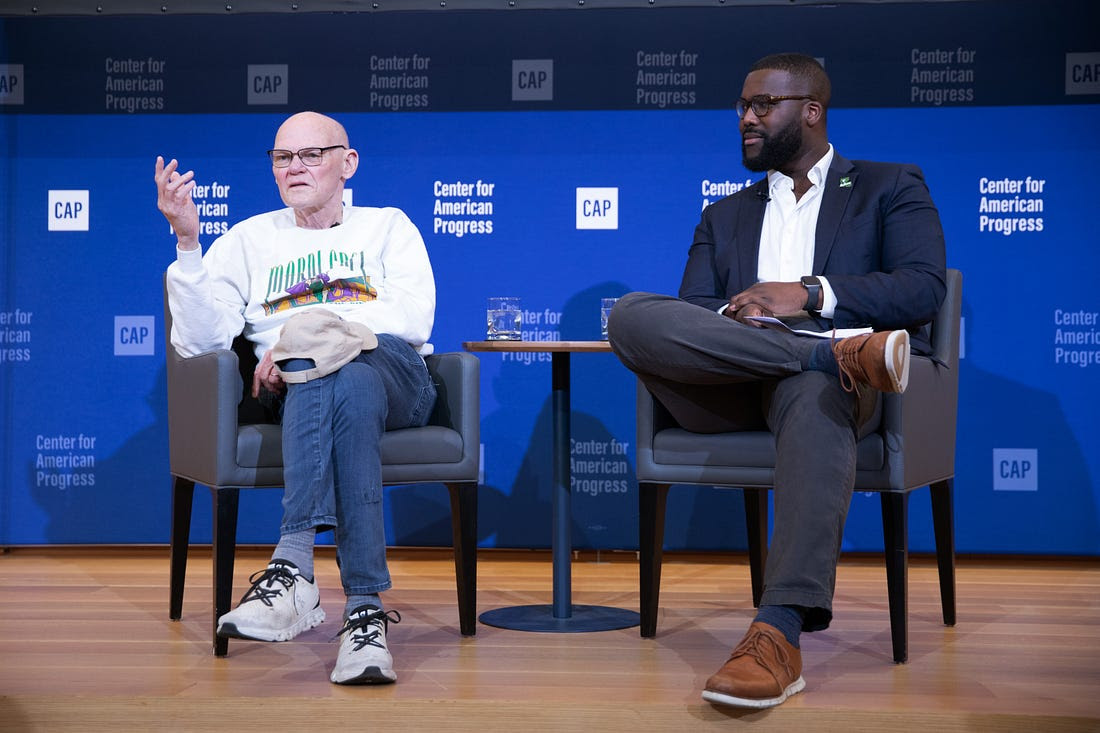
The Center for American Progress hosted a screening for “Winning is Everything, Stupid” with political dynamite James Carville in conversation with Frederick Bell—a setting that felt almost too on-the-nose. Watching a film about political warfare in a room full of people who live and breathe its consequences added an extra layer of electricity, the kind that hums just beneath polite conversation in Washington.
Carville arrived exactly as you’d expect—rumpled, rapid-fire, and radiating that unmistakable Louisiana voltage. He doesn’t so much enter a room as overtake it.
Set against the backdrop of the 2024 election, “Carville: Winning Is Everything, Stupid” documents the decades-long career of political strategist James Carville. Following the documentary screening, The Center for American Progress’ own Frederick Bell, his former student, discussed the defining moments of his career; how campaign strategy and media have transformed over time; and what lessons today’s leaders and organizers can draw to connect with voters, navigate an increasingly complex political landscape, and build campaigns that can both win elections and deliver results, bringing the film’s themes and behind-the-scenes insights into sharper focus.

But before “Winning is Everything, Stupid” fame there was his relationship with Mary Matalin fame. Would Winning Is Everything even exist without the enduring, improbable, and undeniably electric partnership of Mary Matalin and James Carville—or is their relationship the real story Washington can’t stop watching?
In Washington, few relationships have ever been greeted with such a mix of fascination, skepticism, and—eventually—affection as that of James Carville and Mary Matalin. When the two first emerged as a couple in the early 1990s—he the brash, Cajun Democrat fresh off a winning presidential campaign, she the polished, steel-spined Republican operative—official Washington didn’t quite know what to do with them.
But Washington, ever attuned to a good story, quickly recalibrated. What began as curiosity evolved into a kind of grudging admiration. Socially, they were irresistible. Invitations followed—not despite their differences, but because of them. Hosts knew that placing Carville and Matalin on a guest list guaranteed a certain spark, a conversational voltage that could lift even the most dutiful Washington dinner out of polite monotony. They weren’t just attending the party; they were the party’s subtext.

Mary Matalin and James Carville. Photo courtesy of NPR
Personally, I’ve seen a different side of that world—one far removed from campaign war rooms. Years ago, I attended the wedding of our mutual friend Ann Klenk at the Virginia home of Carville and Matalin. I arrived in a limousine with Helen Thomas, champagne in hand, only to discover we were hardly alone in making a champagne entrance. Guests arrived in similarly festive spirits, and the tone was set less by protocol than by personality—hosts and wedding party included. What I remember most wasn’t the politics, but the ease of it all: the laughter, the loosened edges, the sense that even in a town defined by its sharp elbows, there are moments—rare and genuine—when everyone simply enjoys the party.
“James Carville is a political warrior who spares none from his spears. A true American treasure.” Ann Klenk, veteran TV producer
In the end, Winning Is Everything simply drops you into the room, lets the noise and urgency wash over you, and reminds you—subtly, but unmistakably—that in this town, relevance is fleeting, but the hunger to win never is.
““Winning Is Everything “ charges headfirst into the combustible orbit of James Carville, a man who treats elections less like civic exercises and more like full-contact sport with a ticking clock.” Matt Tyrnauer, Director
“Just Watch it Stupid”. Los Angelos Times
Watch trailer here.