
A Small Town's Big Day
The latest from Hollywood on the Potomac.
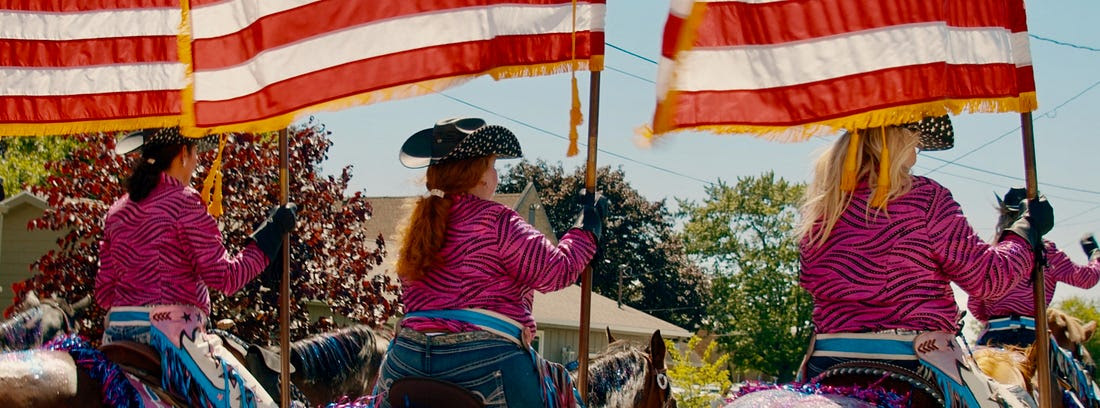
Photo credit: Courtesy of Production
In Flag Day, filmmakers Andrew and Melissa Shea follow a Michigan community whose annual parade offers Washington something to think about.
Washington could learn a thing or two from a parade route that runs about half a mile. In Three Oaks, Michigan, people who disagree politically still speak to one another, veterans command the community’s affection, and the most coveted date on the calendar arrives in June. Christmas, apparently, has competition.
“This is the day of the year that everyone looks forward to,” says filmmaker Andrew Shea.
He and his wife and filmmaking partner, Melissa Shea, found more than an irresistible slice of Americana in the town’s annual Flag Day celebration. They found the subject of Flag Day, an observational documentary about the pleasures, obligations and occasional complications of belonging somewhere.

On Veterans Day, November 11, that small Michigan community will have its Washington close-up when the United States Navy Memorial screens the film, followed by a conversation with the filmmakers and retired Navy veteran Albert Brayboy Jr., one of its central participants.
The Sheas’ route to Three Oaks began with a job Andrew didn’t take.
In 2012, an opportunity at Notre Dame brought the couple to the region, where they discovered the Lake Michigan area known as Harbor Country. They stayed in Austin, Texas, but returned north for summers with their young children, becoming seasonal residents in 2013.
Then came the babysitter.
Hired to help while the couple worked on a film, she invited them to the Flag Day parade in her hometown. She happened to be Miss Three Oaks, riding atop a float. For the Sheas, an afternoon outing became a family tradition—and, eventually, a film.

“And also, it really brought the town out and together, which is something coming from California and New York we had never seen,” Melissa recalls.
They went back year after year. By the time the 2024 election approached, the parade seemed a promising way to observe a community against the backdrop of a country increasingly defined by its divisions.
The celebration would provide the structure. The people would supply the story.
“The real story is about this community, this small town in Southwest Michigan,” Andrew says.
For a filmmaker raised in New York City, the scale alone offered a certain charm. The parade route is short enough that, as Andrew explains, some participants finish before others have properly begun. Its importance, however, is another matter. Families return, neighbors turn out, and a local tradition becomes the occasion around which the town gathers.

The Sheas discovered that the connections extended well beyond parade weekend.
“They really like each other,” Melissa says. “I mean, the community’s very intertwined, surprisingly intertwined.”
Those relationships became part of the filmmakers’ own lives. The family whose daughter first babysat for them remained close; another sister later took over. Over the years, Melissa watched children grow up and make choices that challenged her assumptions about ambition and leaving home.
One became a nurse, married her high school sweetheart and started a family. A son took over the family business. Staying, she came to understand, could be a deliberate and satisfying choice.
“So I think that early on, I didn’t understand this idea of being tethered to a place, really having those community and family connections that make you want to stay,” she says. “I think there’s a really nice quality of life that it has taken me years to appreciate and really see.”
It is an unusually candid admission from someone whose profession depends on looking closely. Familiarity changed what she saw.
Andrew understands the appeal, too. With their own daughter living in New York, the proximity of generations in Three Oaks has acquired a personal resonance.
“And I’m jealous in a way of the closeness that some of those families, that community has,” he says.

Still, affection does not turn Three Oaks into a town without problems. Andrew describes rising housing costs, newcomers arriving from Chicago and a local economy shifting away from its traditional farming base toward services and tourism. The same appeal that draws visitors can make it harder for young people to remain.
“But it’s complicated,” he says.
That complication gives the portrait its texture. A community can cherish continuity while changing around the people who created it. Children can want to stay and struggle to afford it. Those who leave can still regard parade weekend as the time to come home.
The local American Legion became a hub for the production, bringing the filmmakers into the lives of veterans whose service occupies an important place in the town’s identity. Among them was Brayboy, who emerged as an emotional center of the film. The documentary is dedicated to his father.

Andrew Brayboy and his veteran father
For Andrew, Brayboy also embodies a habit that deserves attention well beyond Michigan: maintaining friendships across political differences.
“Albert is very open about his political views when he’s asked, and he certainly doesn’t agree politically with all of his friends and other Legion members in Three Oaks, but he still talks to everybody,” he says.
“I mean, I think that’s the difference is people talk to each other even if they don’t agree on everything.”
It is a modest observation with considerable Washington relevance. The Sheas describe people who continue to participate in one another’s lives despite disagreement. Shared history, service and the work of putting on a parade give them reasons to keep showing up.

The filmmakers are eager to bring that conversation to the Navy Memorial. Some of their subjects are planning to make the trip as well.
“They’re bringing a caravan from Michigan,” Andrew says. “I think they’re really excited and honored that their town is going to be profiled in this really amazing place.”
At screenings elsewhere, Melissa has noticed a response that suggests the film is touching something audiences miss.
“I think it reminds you that there’s something beyond the kind of tension in our society right now,” she says.
Her hope is that viewers leave thinking about their own neighborhoods and the part they might play in them.
“We’d like people to remember that there’s ways to connect in your community to make a difference, whether it be small or large, that’s kind of where it all begins.”
For Three Oaks, that might mean helping a neighbor, honoring a veteran or making sure the parade comes together for another year. For Washington, an afternoon spent in their company seems a promising place to start.

Flag Day screens Wednesday, November 11, 2026, at 2 p.m. at the United States Navy Memorial’s Arleigh & Roberta Burke Theater, 701 Pennsylvania Avenue NW. Admission is free. The 75-minute film will be followed by a panel and audience Q&A with Andrew Shea, Melissa Shea and Albert Brayboy Jr. Details and registration.