
Sixty-Five Years in the Swamp -- and Still Making Waves
The latest from Hollywood on the Potomac.
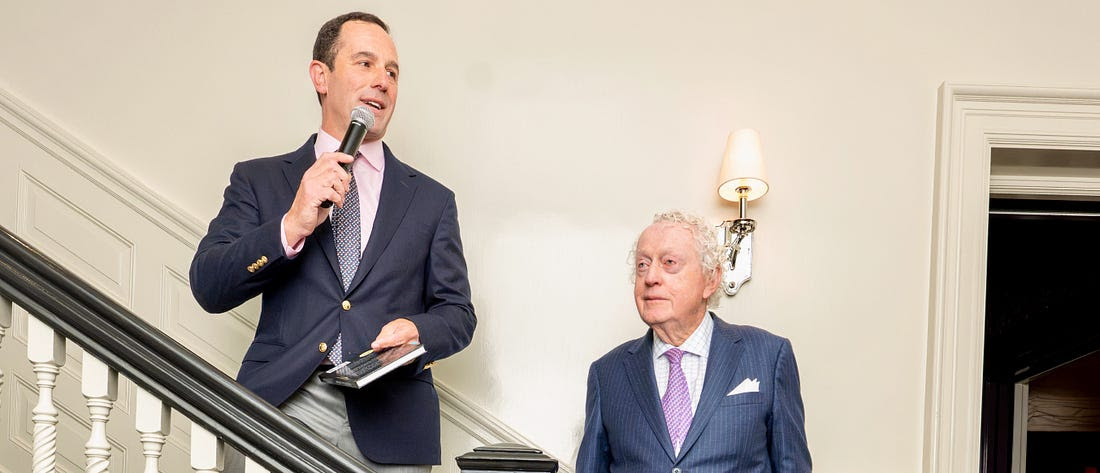
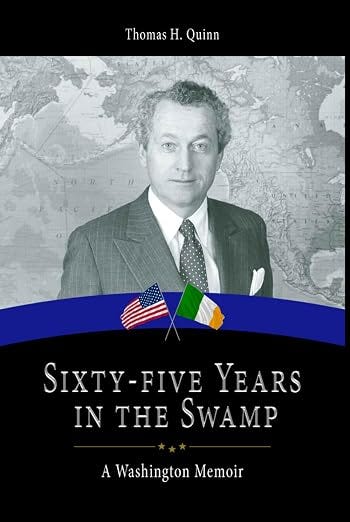
Washington is a city where everyone has a story, everyone knows someone, and almost nobody tells everything. Thomas H. Quinn, however, has had 65 years to collect the evidence. And with the publication of his new memoir, Sixty-Five Years in the Swamp: A Washington Memoir, he’s finally talking.
The occasion was an intimate book party at the home of Dave Grimaldi and Metta Grokenberger, where friends and Washington insiders gathered to celebrate a man who has spent more than six decades navigating the personalities, politics, power plays, and peculiar charms of the nation’s capital. In a town famous for its revolving doors, Quinn has demonstrated remarkable staying power. And as his memoir suggests, surviving Washington is one thing. Understanding it is quite another.
Grimaldi, playing host and master of ceremonies, introduced Quinn with the enthusiasm of someone who had not merely read the book but lived among many of its characters. “Metta and I could not be happier that you are here to celebrate the greatest legend in the history of the Beltway and the history of Prospect Street, M Street, Wisconsin Avenue,” he told the gathering.
For Grimaldi, the evening was personal. Quinn had known his father for decades, and his influence extended well beyond the professional world. “Tom has meant more to me in my professional and personal life than he will ever know,” he said. “He has shaped my character. He has shaped my professional ability, my advocacy ability.”
Then came a declaration guaranteed to raise a few eyebrows outside the Beltway. “Lobbying is the most noble profession,” he proclaimed, quoting from Quinn’s book. “We don’t wear scarlet letters. We are proud messengers.”
He also recalled one of the more colorful episodes from Quinn’s early lobbying career: helping facilitate the opening of Georgetown institutions 1789 and The Tombs in exchange for a rather unconventional fee—a year’s worth of free drinks. “His retainer has gone up slightly since then,” he quipped.
But beneath the laughter was something more poignant: a tribute to a Washington that many in the room remembered fondly, a place where political opponents could disagree without becoming enemies and where compromise was not considered a character flaw.
Grimaldi described Quinn as representing “an era of civility, of partnership, compromise, decorum, respect, collegiality.” And then it was the guest of honor’s turn.
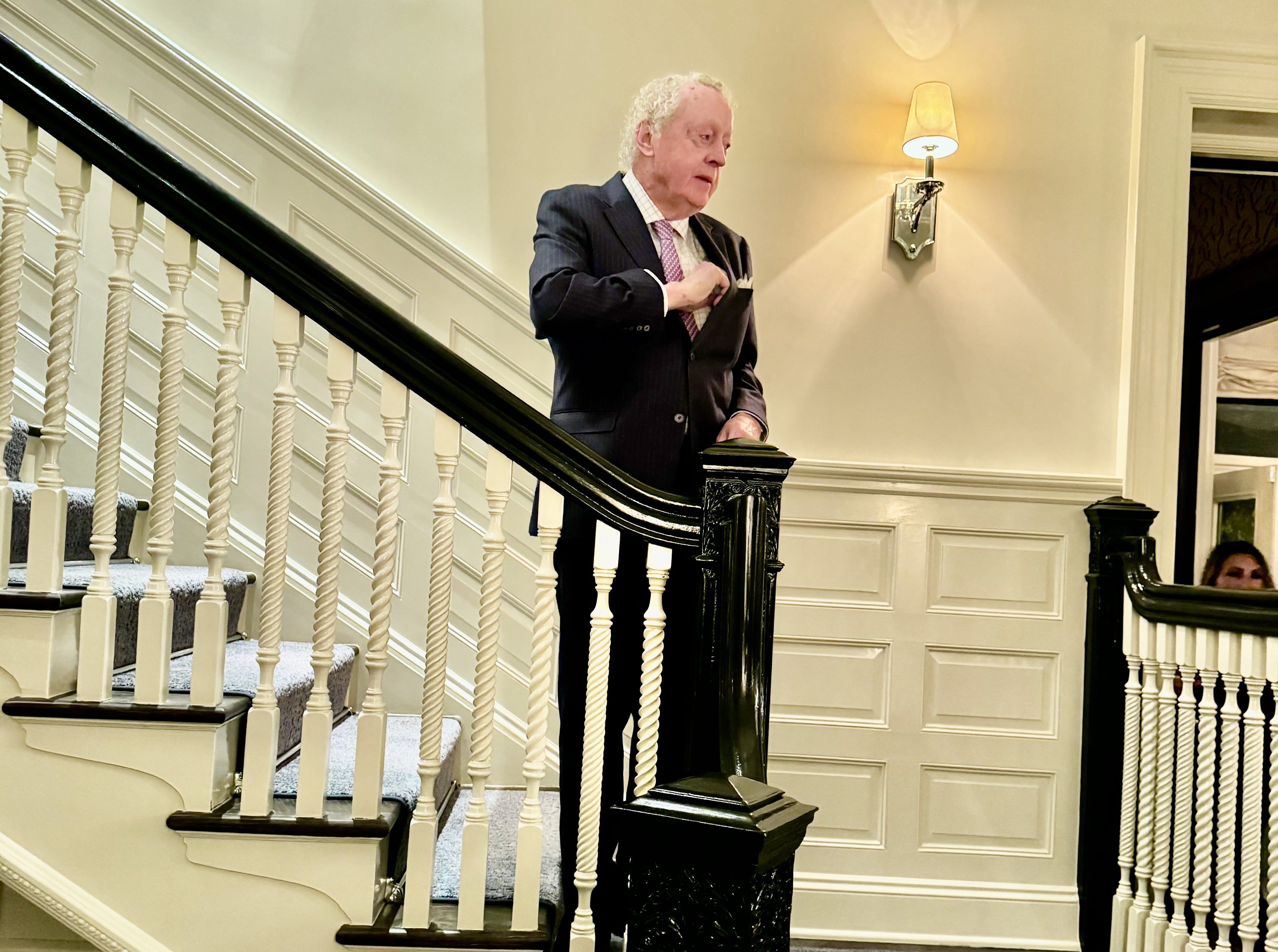
Photo credit: Janet Donovan
Quinn approached the microphone with the easy confidence of a man who has addressed countless rooms and probably knows half the people in most of them. “As the Irish say, we hope these brief comments will improve upon silence,” he began. “Oftentimes it’s not the case.”
For Quinn, Washington’s much-maligned swamp is not something to be eliminated but something to be understood, appreciated and occasionally repaired. “We certainly don’t want to drain the swamp,” he explained. “We want to improve it as it goes along here and there. We know it’ll never be perfect.”
He recalled a recent conversation with his friend John Kerry about the inefficiencies of democracy, complete with a decidedly adult analogy. “As John said though, why is democracy like sex? When it’s good, it’s very, very good. And when it’s bad, it’s still good.”
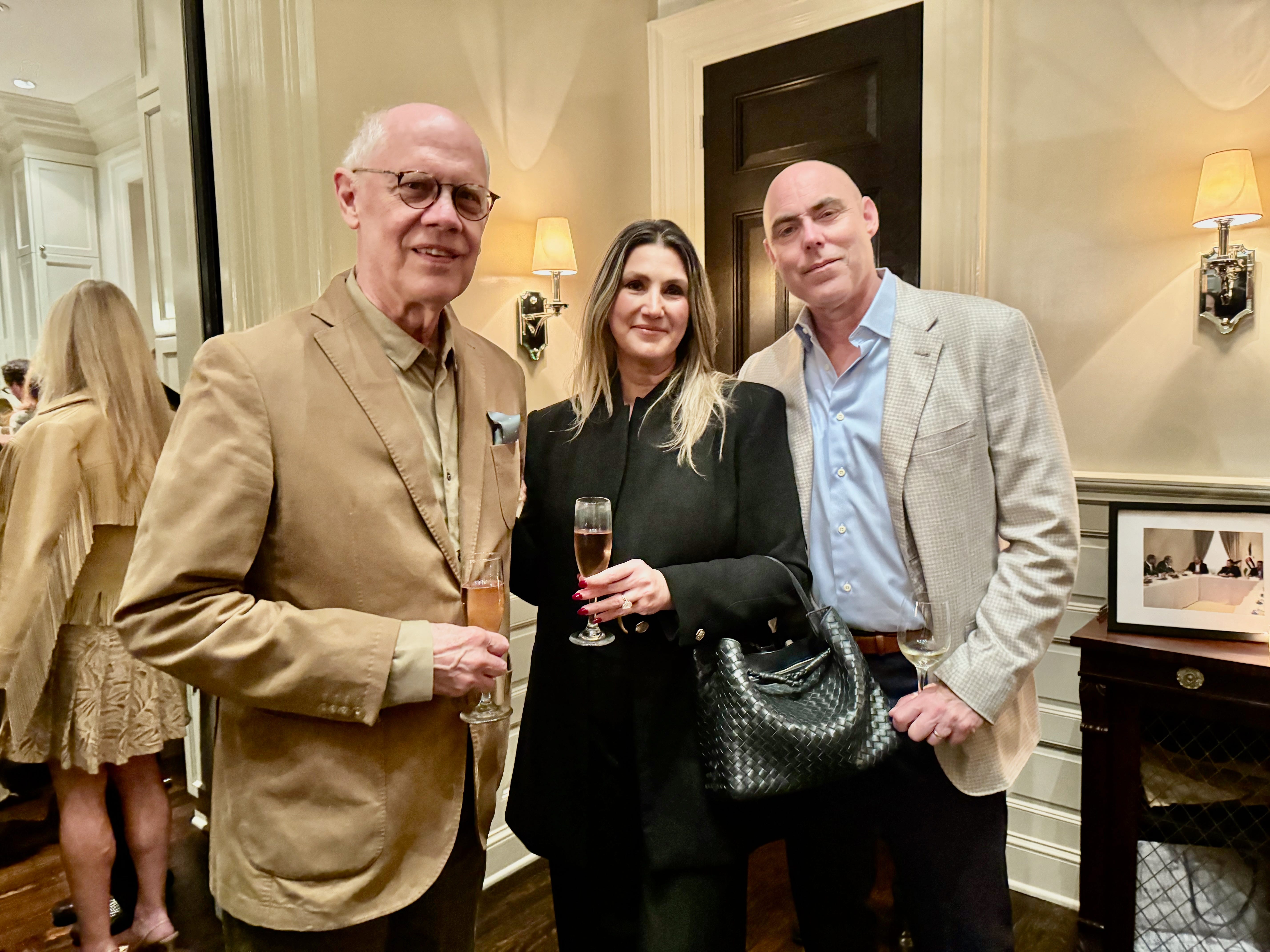
Kevin Chaffee Virginia Coyne. Rob Denegger. Photo credit: Janet Donovan
It was vintage Washington storytelling: a little politics, a little philosophy, and just enough mischief to keep everyone listening. Quinn has witnessed an extraordinary sweep of American history, from the Kennedy years through Vietnam, the Cold War and the political upheavals of today. He reminded his audience that while every generation believes it is living through unprecedented turmoil, history has a way of providing perspective.
He recalled 1968, when Robert F. Kennedy and Martin Luther King Jr. were assassinated and the Vietnam War was taking a devastating toll. “Those are serious times,” he said.
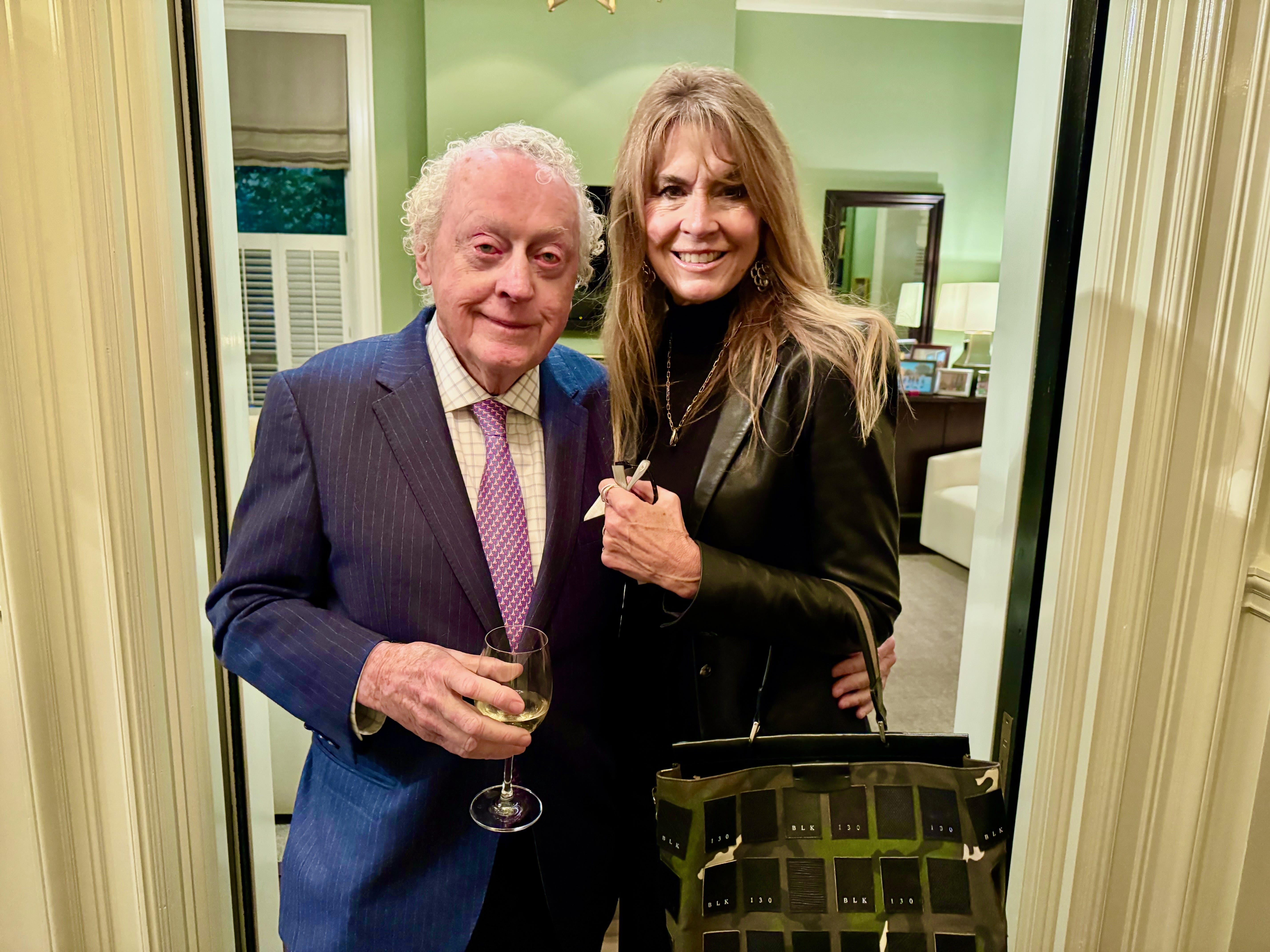
TQ and Lynly Boor Photo credit: Janet Donovan
There was also room for a bit of Georgetown lore. Quinn credited Rhode Island Congressman Freddie St. Germain with one of Washington’s more enduring legislative accomplishments: changing the District’s drinking laws. “The Kennedy Johnson stuff goes on and comes and goes, but the drinking laws are still here,” Quinn observed.
Yet perhaps the most revealing moment of the evening came when Quinn turned from political personalities and historical anecdotes to the one principle that has guided his career: personal relationships.
And that was precisely where our subsequent conversation for Hollywood on the Potomac began.
The interview: The Man Who Knows Where the Stories Are Buried
Quinn arrived in Washington in 1960 as a freshman law student at Georgetown University, just as John F. Kennedy was electrifying the political landscape. Having served in the Army, he found himself drawn into the excitement of the Kennedy campaign. “During law school, we’d go down to the Democratic headquarters and make phone calls and help the campaign,” he recalled. It was the beginning of an extraordinary Washington education, one that would eventually take him into the orbit of presidents, senators, power brokers and some of the capital’s most memorable personalities.
So what has changed in 65 years?
“It has changed in a sense,” he acknowledged, describing the current administration as unusual. But he believes that, away from the cameras and political posturing, relationships between members of Congress remain more cordial than the public might imagine.
And what about the profession that has defined much of his career?
“Everybody has a lobbyist from the biggest corporation in the world to the homeless and the less fortunate and the hospitals and healthcare,” Quinn explained. His point was simple: lobbying is advocacy, and advocacy is how Washington works.
But enough about policy. What about the personalities?
Asked which political figure was the most unforgettable, Quinn didn’t hesitate long.
“I guess Trump is the most unforgettable,” he said.
And the most astonishing political upset?
“That Donald beat Hillary Clinton in 2016,” he replied, recalling the election that confounded expectations.
When the conversation turned to Washington’s more outrageous moments, Quinn reached back to Abscam, the notorious FBI undercover investigation that ensnared members of Congress in the late 1970s and early 1980s. It was quite a colorful episodes,” he recalled, describing the operation in which agents posing as wealthy Arab investors offered bribes to public officials. Quinn remembered Senator Harrison Williams, a friend who went to prison as a result of the scandal, and the controversy surrounding the government’s tactics.
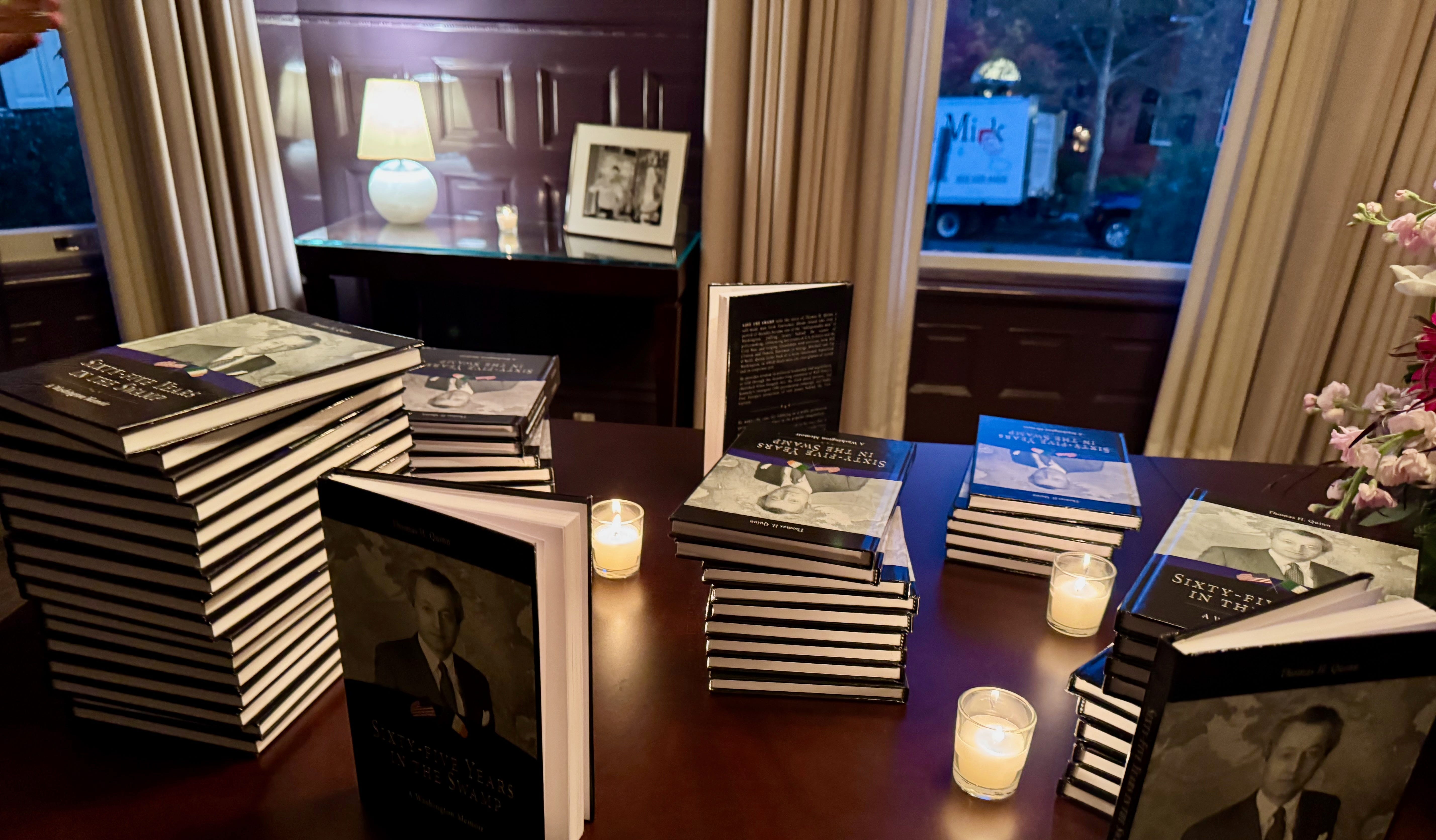
Photo credit: Janet Donovan
Then came a question about the intersection of charm and hardball.
Who was the most charming politician who also knew how to play hardball?
Quinn initially resisted describing Lyndon Johnson as playing hardball, preferring the word “effective. In Washington, apparently, charm and ambition have never been mutually exclusive.
Power, Politics and the Art of Knowing Someone
One of the more consequential chapters in Quinn’s career came in 1973, when President Richard Nixon appointed him to the Board for International Broadcasting. The appointment placed him in the middle of a struggle over the future of Radio Free Europe and Radio Liberty, broadcasters that played important roles during the Cold War. “We saved Radio for Europe, Radio Liberty,” Quinn recalled, describing what he considers one of his most meaningful contributions. He believes those broadcasts helped sustain access to independent information behind the Iron Curtain and contributed to the political changes that culminated in the fall of the Berlin Wall in 1989.
For a man who has spent much of his life behind the scenes, it was a reminder that influence isn’t always measured in headlines.
Another figure who left an impression was Congressman Dan Rostenkowski, the powerful chairman of the House Ways and Means Committee during the great tax battles of the 1980s. Quinn remembered the lesson: knowing the president is useful, but knowing the chairman of Ways and Means can be even more consequential when tax legislation is on the table.
And then there is the matter of political egos.
He remembered Senator Ernest Hollings of South Carolina, who, when asked the secret of his long marriage, reportedly answered:
“That’s easy. We’re both in love with the same fellow.” Washington has never suffered from a shortage of self-confidence.
Secrets, Scandals and Social Climbing
Of course, no Washington memoir would be complete without a few scandals, some spectacular falls from grace and the delicate art of knowing when to keep one’s mouth shut.
Which is more valuable in Washington: knowing a secret, keeping a secret or knowing whom to tell?
“Probably knowing who to tell,” Quinn replied. There, in five words, was an entire graduate course in Washington survival. (And why this interview was edited)
Quinn has watched promising careers collapse over mistakes that, in retrospect, seem almost incomprehensible. He mentioned former Senator Bob Menendez, whose corruption conviction and prison sentence represented, in Quinn’s view, a particularly sad political downfall.
And what about social climbing, that other great Washington occupation?
“Social climbing, that’s not an unusual occupation, as you know,” he observed. An understatement worthy of its own chapter.
But for all the scandals, Quinn’s memories are not dominated by cynicism. Some of his most cherished moments involve the exhilaration of politics when it still seemed capable of changing the world.
A Night at the Mayflower: Asked about the happiest moment of his Washington life, Quinn returned to the beginning.
It was election night, 1960, at the Mayflower Hotel. He and his fellow Kennedy supporters stayed awake waiting for the returns and “when the results finally came in from Illinois and Kennedy had won the election, it was probably the most exciting time,” he recalled. For a young law student newly arrived in the capital, it was the beginning of an era that would shape the rest of his life. The Kennedy inauguration also remains among his most memorable Washington celebrations, a moment when a new generation seemed poised to take charge.
But nostalgia only goes so far with Quinn. He remains fascinated by the machinery of power, the people who operate it and the personal relationships that make the city function.
Even his memories of the Irish peace process carry a distinctly Washington twist. Despite his involvement in those efforts, Quinn recalled finding himself excluded from White House events during the Obama years because of restrictions involving lobbyists. “It was a big mistake on their part because they lost lobbyists - the best talent in town to help run the government,” he argued. It’s a sentiment that neatly captures Quinn’s enduring defense of his profession.
One More Dinner, One More Story: If Quinn could summon one great historical figure for a long dinner, who would it be?
“Perhaps Winston Churchill,” he mused. The imagined evening would include a cigar, good brandy and, presumably, a conversation that might last until morning. Franklin D. Roosevelt also made his list, a president Quinn admires for his leadership and transformation of the country during the Great Depression.
But one question remained: After 65 years in Washington, countless political adventures and enough material to fill several memoirs, was there a story Quinn deliberately left out of the book because telling it might cause too much trouble?
“I think I’ll pass on that one maybe,” he replied - Quinn’s affectionate defense of old Washington and his mischievous reluctance to reveal its secrets.
And there it was.
The man who has spent 65 years watching Washington, who knows its characters, its triumphs, its embarrassments and its secrets, still knows exactly when not to talk.
Some things, apparently, remain off the record.
Which may be the most Washington thing of all.