
A Scandal in the Family
The latest from Hollywood on the Potomac.

Photos by Marvin Bowser
On Connecticut Avenue in DC, where Washington occasionally puts down its briefing papers and picks up a novel, Politics and Prose welcomed Cal Hoffman for a celebration of Judah Can’t Tell. The setting suited a book about a city fluent in ambition, practiced in discretion and forever surprised when the family secrets make the morning headlines. Hoffman, who has known Washington since boyhood, had brought a fictional senator’s troubles to a town with considerable experience in the genre.

Washington was the family business long before it became Cal Hoffman’s fictional terrain. He arrived in 1967, a 10-year-old whose father’s work would take him through the machinery of government: antipoverty legislation, economic policy, tax reform and, eventually, research into corporate corruption. For a future novelist, it was an education in how the city worked—and what people said when the official business was over.
“So I lived in Washington from age 10 on, and I just knew a lot about politics,” Hoffman recalled. “I knew a lot of the people. I knew the gossip from about 1967, 68 on.”
Columbia, London, Chicago and two decades in New York followed. But Washington had supplied material that would travel with him. He and his wife returned in 2014; a few years later, he began writing Judah Can’t Tell, the novel celebrated at the recent Politics and Prose book party.

Cal and Michael Isikoff

Christina Sevilla
Its characters are invented. Its questions—about power, professional responsibility and the distance between good intentions and actual conduct—draw on concerns that had occupied him for years. In 2005, Hoffman worked on a story about a major accounting scandal, collaborating with a whistleblower whose testimony, he said, helped bring about a $400 million settlement. That experience helped seed the novel, including its interest in the consequences of exposing wrongdoing.
In Judah Can’t Tell, however, the first person confronting an unwelcome revelation is a son.
At six in the morning, Harris Belkin is scrolling through The New York Times when he encounters a headline about accusations against a senator. The face accompanying the story belongs to his father, Symon.
For all the political maneuvering in Judah Can’t Tell, its most intimate contest concerns a father trying to protect his son while still struggling to understand his own father. Harris wants to preserve Judah’s innocence, but the boy’s growing awareness challenges the explanations the adults have learned to live with. Being needed as a father and being understood as a man turn out to be very different propositions.
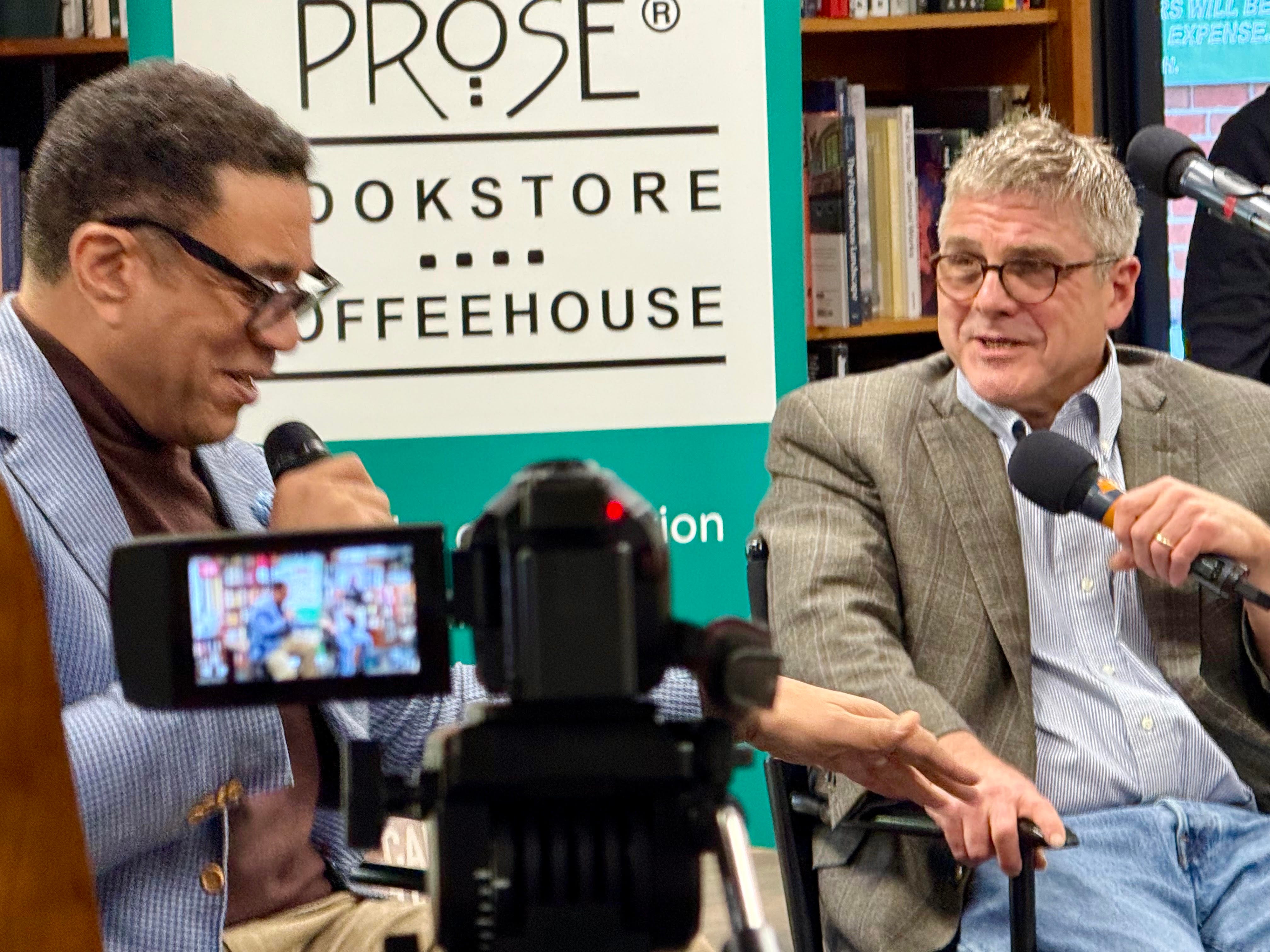
Lennix and Hoffman
Hoffman allows his characters the possibility of recognizing that difference. “And with awareness comes a possibility of making the better choice and returning to one’s original goodness.”
Getting there requires a willingness to look a little foolish. Hoffman finds humor in the gap between his characters’ intentions and their behavior, and in those moments when their carefully maintained defenses begin to slip. “I actually think the only way to begin to engage with Washington in a meaningful way is through humor, is through seeing the absurdity, because humor in essence is human vulnerability.”
Beneath the scandal, then, lies a quieter question: Can Harris stop trying to recover the father he remembers long enough to become the father his own son needs? It is a reckoning with implications far beyond the Belkin family, particularly in a city where listening can become a pause between assertions of one’s own importance.
“Because real moral action is being secure enough that you can listen to other people, hear what they need, hear what they want,” Hoffman said.
Washington will always have another headline. Hoffman leaves his readers with the more enduring business of what happens after it—when the explanations have run out, the family is still there, and someone must finally listen to the child.
Washington has another scandal. Harris has his childhood back.