
The Runaway Nun
The latest from Hollywood on the Potomac.
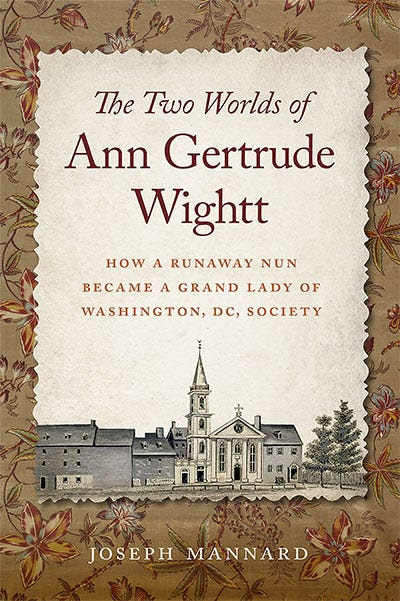
It reads, at first blush, like a plot engineered for intrigue: A 15-year-old girl dispatched toward the convent, only to reemerge—spectacularly—as a grande dame of Washington society. But beneath the cinematic arc of “The Two Worlds of Ann Gertrude Wightt” lies a more disquieting question, one that lingers long after the page is turned. What kind of family, in any era but especially one brushing up against modernity, decides that the appropriate destiny for an adolescent daughter is religious seclusion?
Is it an expression of devout conviction, a strategic bid for respectability, or something more transactional—a quiet negotiation between class, gender, and control? And perhaps more intriguingly, what does it say about the social machinery of the time that the same young woman could later reinvent herself so completely, trading the discipline of the convent for the delicate theater of Washington’s elite drawing rooms?
Author Joseph Mannard’s telling doesn’t just chronicle a transformation; it invites us to examine the scaffolding of belief and ambition that made such a transformation necessary in the first place. He was the honored guest at Tudor Place in Georgetown where we snagged a fascinating interview.
“I find it very interesting that a 15-year-old from a predominant family ends up thinking that it’s a great idea to be a nun. Why would anybody-think that putting their 15-year-old in a cloister is a good idea? That, of course, would be the first question to ask the author, which we did.”
“Well, the mother did it after the father died. She was born in 1799. Her father died in 1802 and then her uncle who took them (the children) in, who was quite well off but he died in 1806. The following year is when the mother put her under the protection of the Archbishop and the mother superior,” explained Mannard.
The lineage thing is complex and complicated so we will reduce it to the description offered by Georgetown University Press to bypass the early years in a boarding school and the death of her sister from Tuberculosis when she was twenty.
“In 1831 Sister Gertrude Wightt, the directress of Georgetown Academy (now Georgetown Visitation Preparatory School), donned the hat and cape of one of her students and abruptly left the academy and life as a nun. She soon became a fixture on the Washington social scene and an intimate of Dolley Madison.
The Two Worlds of Ann Gertrude Wightt is the first comprehensive biography of the enigmatic Wightt. Drawing from a rich cache of previously overlooked primary sources, the book meticulously explores Wightt’s transformation from respected academy directress to celebrated “parlor politician” in the nation’s capital. It delves deeply into her innovations in female education, her unprecedented departure from convent life, and her remarkable social reinvention. The author reveals a complex narrative of the opportunities and limitations that Catholic religious life posed for this gifted, ambitious, and socially prominent young woman.
Scholars of American women’s history and Catholicism, as well as general readers, will find an illuminating exploration of how one woman navigated and transcended the rigid boundaries of her time. This book also offers a profound window into the intersections of gender, class, and institutional power in nineteenth-century America, resurrecting this forgotten historical figure who challenges our understanding of women’s experiences in the early American Republic.” Thank you GTUPress.
Read more here.