
Nutcase or Powerhouse?
The latest from Holywood on the Potomac.

Written by contributor Kandie Stroud
Photo credit: Misc.
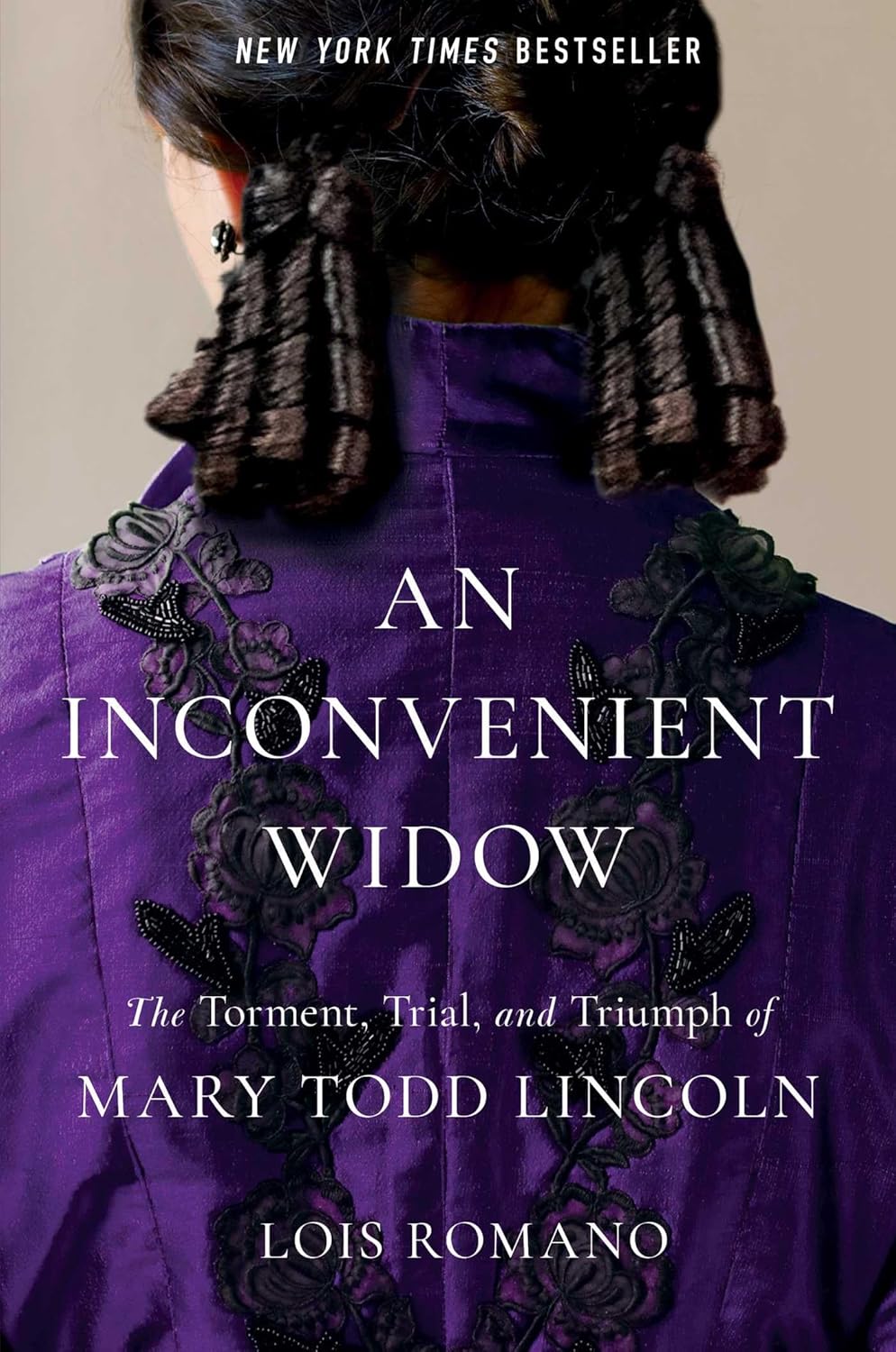
Mary Todd Lincoln’s reputation has filtered down through the annals of history as a rather erratic and unstable First Lady. Terms like madwoman have sometimes been applied. And did I mention shopaholic? In her new book, An Inconvenient Widow: The Torment, Trial and Triumph of Mary Todd Lincoln (Simon & Schuster, May 2026), author and political journalist Lois Romano attempts to set the record straight-- at least to apply a fresh and more compassionate coat of paint to the stereotypical portrait of the former First Lady.
On the stage at Ford’s Theater, mere feet from where Lincoln was shot at point blank range as Mary sat holding his hand, Romano engaged in a wide ranging hour-long interview with philanthropist, author and Carlyle group co-founder David Rubenstein. Rubenstein knows history better than most which made for a riveting conversation. Romano presented Mrs. Lincoln in a softer, gentler light, claiming she had been unfairly criticized and that many of her flaws were exaggerated. She was a “resilient and brilliant woman,” said Romano. She was politically savvy, highly educated and an indispensable partner in her husband’s presidency.
And much of her bizarre behavior could likely be attributed to the many tragedies that had beset her life, including the early death of her mother, the deaths of three sons and her husband’s traumatic assassination.

Photo credit: Courtesy of Ford’s Theatre
And perhaps a woman called insane and hysterical by 1860’s standards would today be considered tenacious, indomitable, savvy, commanding, strategic, assertive, steel-willed. In short, a badass.
Off the bat, Romano dispelled stories that Lincoln never really loved Mary, recounting how the Lincolns shared a deep love for each other from the very start of their relationship. Romano described how Lincoln became so despondent when they broke up during their courtship that he came very close to a nervous breakdown. “He was circling the drain.” In January of 1841 Lincoln was supposed to have escorted Mary to a party but he was late. Tired of waiting, Mary went ahead without him. When Lincoln arrived at the event, he found Mary bodaciously flirting with attorney Edwin Webb, sending the future president into a jealous rage. Lincoln cut off the relationship with Mary that night. It was 18 months before they got back together. During that time Mary “was just fine,” said Romano. “She went on dating other men, whereas Lincoln is so upset that he had broken up the relationship and the engagement he went into a deep depression… He was so gloomy and unraveled they even removed the razors from his house for fear he would hurt himself.” Friends intervened to help reunite the couple, the relationship re-ignited and the Lincolns were married in 1842.

Romano portrays Mary as someone who was raised in a political universe. She came from an exceptionally powerful, wealthy and well-connected political family in Lexington, Kentucky. Her father, Robert Todd Smith, was a prominent lawyer, banker and influential Whig politician who served for decades as the clerk of the Kentucky House of Representatives and later as a Kentucky State Senator. The Todd family had elite connections and frequently hosted top political leaders at their dinner table where Mary leaned to dynamically discuss national policy.
In fact, from childhood she harbored White House ambition. “Was Mary interested in her husband running for President of the United States,” asked Rubinstein. “Yes, she was,” said Romano. “When Mary was a teenager she told everybody that she aspired to be First Lady. Her first political crush was Henry Clay who lived down the road from her family. She was enamored of Clay because he ran for president several times. In fact, one time she shows up at Clay’s door and wants to show off her new pony. She’s 13. Clay invites her to join the lunch table. Mary not only dominates the lunch but proclaims, “My father says you will be the next President of the United States. I wish I could go to Washington with you and live in the White House.”

David Rubenstein and Lois Romano. Photo credit: Gary Erskine
That wish came true with Lincoln. Often overlooked is the fact that unlike other women of the time, Mary was totally enmeshed not only during her husband’s political rise but also during his presidency and Lincoln relied heavily on her support and political insights. She was a voracious reader of newspapers, served as a behind-the-scenes strategist, political hostess, advisor and sounding board. She monitored press coverage and provided Lincoln with blunt, trusted assessments of his performance and public reception. Mary even attended the Lincoln-Douglas debates ( Of course, she had a personal interest. Douglas had courted Mary years before she chose Lincoln.
When Lincoln was elected to Congress Mary defied the cultural norms of the era. In those days, wives did not accompany their husbands to Washington, but Mary moved lock stock and barrel to DC with Abe and their son, Robert. The family lived in Mrs. Ann Sprigg’s Capitol Hill boarding house on First Street SE, today the site of the Library of Congress. Mary struggled with the cramped quarters, the swampiness of Washington’s air, the male dominated atmosphere and the lack of parties and activities that included women. After a few months, she upped and moved back to Kentucky where she remained for the remainder of Lincoln’s first term.

Photo credit: Gary Erskine
In 1860 when Lincoln ran for president, it was considered unseemly for presidential candidates to travel around begging for votes. Presidential hopefuls were expected to remain at home and conduct a gentlemanly campaign from their front porch. To that end, Mary deftly turned their Springfield home into campaign headquarters, managed the influx of politicians, journalists and delegates and hosted strategy meetings and elegant buffet dinners.
Rubenstein asked about her reputation for reckless spending both in Springfield, in the White House and beyond.
“That’s not true,” Romano replied. “She managed her money fairly well. When they were redoing their Springfield house she was very, very cheap. In fact, she was always haggling over price with vendors. One time, she argued so vociferously with the iceman he refused to come back.” She had to send another young man to get her ice.
What about her extravagance with the White House budget? Exaggerated, Romano pointed out. “The fact is her budget was considerably smaller than both her predecessor’s and her successor’s.”
Rubenstein asked about how Mary was treated when she and Lincoln moved to the White House. “Is she treated as a great next first lady?” “No. She’s treated as a country bumpkin,” says Romano. “Up until that point most of our presidents had come from North and South. Illinois was considered hillbilly territory. Nobody appreciated the fact that Mary was highly educated…more educated than Lincoln. She was the most educated first lady ever to set foot in the White House at that point, but people totally underestimated the Lincolns.”
Of course, she had an imperious side, “She even wanted to be called Madame President,” Romano admitted, “and she had worked hard to get there and expected to be treated well.” However, in those days of rampant misogyny, men didn’t take kindly to a politically savvy and heavily involved First Lady. The women didn’t embrace Mary either. “In fact, at one point a bunch of women got together to come and have a conversation with her about how to act in Washington…It did not go well.”

Then, during the Civil War, there was suspicion that Mary must be on the side of the enemy because her family lived in Confederate states like Kentucky. “Did she ever have divided loyalty,” asked Rubinstein? “Never!” exclaimed Romano.
Rubenstein asked about the Lincoln bedroom saga. “Mary had bought the famous bed at a fancy Philadelphia store. It was very ornate and carved out of rosewood but Lincoln hated it and never slept in it. Although it’s still there to this day.”
The bed became part of another Lincoln tragedy. “I think one of their sons died in it,” said Romano. “One night they had a big ball in the White House. Mary had tried to cancel it because two of their sons were extremely sick. They had become ill due to the bad drinking water. DC was a swamp and even the most rarefied address in the country wasn’t protected from that. Mary spent the entire night running up and downstairs taking care of the boys. But only one son survived. The other, Willie, did not. The death of her second child afflicted Mary with a deep depression, contributing to the image of her as a mentally unstable person.
Another incident that fed into the crazy Mary theory occurred in March of 1865 towards the end of the Civil War. The Lincolns were invited by Ulysses S. Grant to visit the troops at a military camp, City Point, in Northern Virginia. “Grant takes them out to see the troops. Mary, who is riding in a carriage with Mrs. Grant sees a couple of women riding on horseback alongside the generals and Lincoln. “Mary goes berserk. She doesn’t understand why those women are riding next to her husband. She just plain has a meltdown, a psychotic break. It’s been attributed to jealousy but I don’t see it that way. I see it as she just had so much weight on her. She was not doing well mentally because of all the deaths. And she was convinced the troops would think that the woman on horseback riding next to the president was her. She felt dismissed. She acted poorly. She berated the woman and demanded that Grant fire the General whose wife it was.” Julia Grant considered Mary’s behavior that day completely unhinged and deeply embarrassing. As a consequence, the next month, when President Lincoln invited the Grants to join him and Mary in their box at Ford’s Theater, Julia Grant replied, “Over my dead body.” Regretting that invitation on April 14, 1865, saved their lives.

Photo credit: Courtesy of Ford’s Theatre
The night of the assassination even as her husband lay dying Mary was subjected to profound misogyny. The men around Lincoln excluded her from the room. “Ultimately, Lincoln’s body was carried across the street to what’s known as Peterson’s house, a rental house,” says Rubenstein. “Correct,” says Romano. “He’s put on a bed there, a very small bed. They kind of put him in diagonally and Mary is outside the room. And he lasts the night, but Mary’s not particularly welcomed in the room; they don’t want her in there, and in addition to that, even as he lay dying, all the powerful men in Washington--senators, and Supreme court justices, and governors, and Cabinet Secretaries are all grabbing onto his family. It’s just extraordinary the amount of people that are let into that room. Mary comes in about every hour, and at one point, she comes in at a little before 7:00 in the morning. He’s still alive, but when she sees him she screams and faints because by now his color had changed and his face is swollen. The way the story goes, is that they say, ‘get that woman out of here and don’t let her back in.’ Twenty minutes later, at 7:22, when Lincoln dies they all say a prayer around his body but they never invite Mary in the room. When the minister comes out and says to Mary, ‘your husband’s dead,’ she is startled and says, ‘Why didn’t you come get me?’ And he replies, ‘Because we thought it was better not to.’ So even in the death of her husband a man makes this decision for her.”
Andrew Johnson, Lincoln’s Vice President, becomes president and allows Mary to stay for five or six weeks in the White House. “When she moves out,” says Rubenstein, “ it was rumored that she took a lot of things with her that maybe she shouldn’t have taken. Any truth to that? “No! exclaimed Romano. “Mary was a hoarder so she had a lot of boxes, but she only took one thing which she asked permission to take was a favorite dressing table, and she asked the building manager if she could take it. He agreed if she replaced it with something which she did. So she only took that one table. All the boxes were hers.”
“Where did she live after she left the White House?” Rubenstein asked. “ It’s such a tragic story,” said Romano. “There was no will. There’s an executor appointed and the money is going to go between her and the two sons. So this executor, David Davis, puts her on an allowance, the equivalent of $50,000 a year, but he just really takes his time settling the estate. She’s a former First Lady, and entitled to leave the White House and have a place to live, but she has no place to live. She checks into the Tremont Hotel in Chicago, but couldn’t afford to stay there, so her son finds her a small place in Highland Park. Eventually, she moves back to Chicago, but she’s transient. At one point she even picks up and moves to Europe.”
“ Why did she want to move to Europe?”asks Rubenstein. “She wanted to get away from the gossip. And she spoke fluent French. She was over there with her son, Tad who was her constant companion and emotional support. When ultimately, she comes back, Tad, who was then 18 but sort of a fragile kid, gets very sick and dies.“
Having buried her four- year- old son Eddie, her eleven- year -old son Willie, and now her third son, Mary is left utterly devastated and psychologically shattered. The ultimate, offence against the traumatized Mary Todd Lincoln occurs when her eldest and only remaining son, Robert, goes into court and tries to get her declared insane, because he claimed her outbursts were embarrassing to him and he commits her to a mental institution. Robert also takes control over Mary’s money. He didn’t want the money, but he was embarrassed by her shopping, the spiritualists and the mediums. And he’s been getting reports that she’s shopping all the time for a lot of stuff she didn’t need and that strange people are coming in and out of her hotel room. And he’s frantic, he’s worried that they’re gonna take her money.”
But the resilient Mary convinced doctors, attorneys, friends and even the press that she was mentally stable and was able to regain her freedom as well as control of her bank account. Concerned about losing access to her money ever again, Mary kept her money with her. “She had almost a million dollars sewn into pockets in her skirt,” said Romano. Talk about deep pockets.
Mary Todd Lincoln died of a stroke on July 16, 1882 at the home of her sister, Elizabeth, the same residence where she and Abraham Lincoln had been married forty years earlier and the day following the anniversary of her son Tad’s death eleven years earlier. She was buried alongside her husband and three sons in the Lincoln Tomb at Oak Ridge Cemetery.

Photo credit: Creative Commons
Wrapping up the hour long interview Rubinstein concludes: “ Based on all the work you did, you would say that she was not insane. She was more or less railroaded into an insanity situation. And basically, there were some misogynistic views that she was too big a spender. Is that a fair summary? “ Replied Romano, “There were times Mary did not act well and she did things and said things that were not appropriate. But my position is that her whole story was never told correctly. A lot of scholarship became available to me so I hope that I told her story in a well-rounded way, so that people can appreciate that she was a consequential first lady.”

Marlene Malek, Debbie Dingell, Stephanie Cutter, David Rubestein, Lois Romano. Photo credit: Kandie Stroud
With that the crowd moved across the street for cocktails and hor d’oeuvres in the stunning new Legacy Hall recently subsidized by the families of Marlene and Fred Malek and the Marcia and Frank Carlucci Charitable Foundation. Seen in the buffet line: Rep. Debbie Dingell (D-MI), Chris and Kathleen Matthews, Catherine Hand, Ambassador Elizabeth Bagley, Brendan and Lila Sullivan, Dr. Susan Blumenthal and Stephanie Cutter.