
Mary Todd Lincoln Walks Into a Georgetown Dinner Party
The latest from Hollywood on the Potomac.
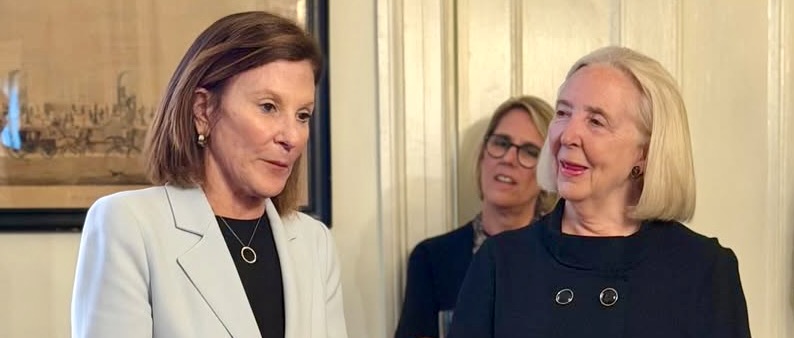
Photo credits: Creative Commons
At Juleanna Glover’s elegant gathering at her DC Kalorama home, Washington’s movers, makers and storytellers came together to toast Lois Romano’s new book, An Inconvenient Widow: The Torment, Trial and Triumph of Mary Todd Lincoln. The evening blended history, politics and literary conversation as guests celebrated Romano’s fresh look at the fascinating and often misunderstood Mary Todd Lincoln. Equal parts salon and soirée, it was a reminder that in Washington, a great book can still be the hottest ticket in town where politics, history, media and power mingle over cocktails and conversation.
The gathering celebrated journalist and author Romano, a veteran reporter and former editor at The Washington Post and Politico, who turned her eye toward one of American history’s most misunderstood women, exploring the turbulent life of Mary Todd Lincoln.

The guest list reflected Glover’s unique ability to convene Washington’s most interesting mix of players—a blend of journalists, political operatives, business leaders, authors and longtime friends. Conversations flowed easily from Lincoln lore to current headlines, with guests swapping stories and debating history’s treatment of powerful women.
The mood was warm, celebratory, and distinctly Georgetown-meets-Kalorama: intellectually curious, socially connected and just glamorous enough. As glasses were raised to Romano’s accomplishment, guests lingered well past the official program, proving once again that in Washington, the best parties are often built around ideas—and the people who bring them to life.

More than 160 years after she occupied the White House, Mary Todd Lincoln remains one of the most controversial women in American history—part tragic heroine, part political operative, part socialite, part survivor.
For Romano, the question wasn’t whether another book about Abraham Lincoln’s wife was necessary. The question was whether history had gotten her wrong. “In that sense,” Romano says, “I feel like she was one of the first modern First Ladies because the coverage of her was unprecedented. Negative and positive—but mostly negative.” That observation could just as easily describe the experience of many contemporary women in politics.
Romano began the project convinced that Mary Todd Lincoln had been denied a fair hearing. Her book is a fascinating new portrait of America’s most misunderstood First Lady, “I thought she got screwed,” she said bluntly. “There’s a much fuller story to be told about her.” And what a story it is.

Imagine serving as First Lady while the nation tears itself apart in civil war. Imagine your brothers fighting for the Confederacy while your husband leads the Union. Imagine losing three children before they reach adulthood. Then imagine watching your husband assassinated while holding his hand.
“What made me feel for her,” Romano says, “was that I don’t think any of her extraordinary losses were appreciated in real time.” She pauses before adding the heartbreaking question that echoes throughout the book: “What’s too long when you lose three kids?”
For generations, historians focused on Mary’s volatility. Romano saw something else. “I felt that she was actually a very thoughtful, smart, generous, kind person and none of that came through.” She was loyal to her family. Loyal to her country. Fiercely protective of Abraham Lincoln. And, according to Romano, ‘politically astute.’ “Every instinct she had was right,” Romano says.

The Inaugural Gown
One example involved William Seward, Lincoln’s future Secretary of State and former rival. Mary distrusted him from the start. “Mary couldn’t stand Seward,” Romano recalls. “Her instincts were very good.” History ultimately proved her concerns were not unfounded.
Yet Romano’s most intriguing conclusion may involve something historians rarely discuss: anxiety.
After consulting mental health professionals while researching the manuscript, Romano began seeing Mary’s behavior through a different lens. “It was an aha moment,” she says. “When somebody said it’s anxiety, it was like a bell went off.” Rather than the caricature of a perpetually unstable woman, Romano saw someone experiencing eruptions of anxiety that would quickly pass. “She would blow up and yell at people and then she’d feel terrible about it.”

One famous example involved an ice deliveryman whom Mary angrily accused of overcharging her. After dismissing him, she regretted the encounter and sent someone to apologize.
To Romano, Mary’s tragedy is partly timing. “She just had a lot of issues that would have been so easy to deal with today,” she says. “Talk therapy. PTSD treatment. Pharmaceuticals.” In today’s world, Mary Todd Lincoln might have looked very different.
Which raises an irresistible question: What would she have been like in modern Washington?
Romano doesn’t hesitate. “She was totally a modern First Lady.” Like Eleanor Roosevelt and Hillary Clinton, Mary was outspoken, influential and frequently criticized for refusing to stay in the background. “She wanted to be seen,” Romano says. She visited wounded soldiers. Traveled to military camps. Appeared publicly in support of the Union cause. She wasn’t interested in merely cutting ribbons.
As for social media?
“The media would’ve been all over her twenty-four-seven,” Romano laughs. Yet she believes Mary would have benefited from the protections modern First Ladies enjoy: communications teams, advisors, therapists and staff dedicated to protecting both image and legacy.
And if Mary Todd Lincoln found herself transported to Washington’s contemporary social scene? Romano imagines her at Georgetown dinner parties, embassy salons, and gatherings filled with intellectuals, diplomats, and journalists. “She liked smart people,” Romano says. “She loved intellectual exchange.” She was bilingual, widely read, politically obsessed, and consumed newspapers voraciously. “I think she would’ve liked reporters,” Romano says, before adding one important caveat. “But only high-stature reporters.” Sorry, gossip columnists. Or perhaps not entirely. Romano discovered another side of Mary. “She was funny,” she says. “She was a mimic and she was a gossip.”
In fact, when asked whether she and Mary might have been friends, Romano didn’t dismiss the possibility. “I think so,” she says. “I could see standing on the side of a party with her and saying, ‘Did you hear so-and-so did that?’”
That image lingers long after the interview ends: Mary Todd Lincoln, standing in the corner of a Georgetown salon, exchanging observations about the political class, charming everyone around her despite herself.
Not because she was perfect.
Not because she was easy.
But because she was human.
And perhaps that’s Lois Romano’s greatest achievement. After years spent examining one of history’s most misunderstood women, she doesn’t claim to have solved the mystery of Mary Todd Lincoln. She has simply made us see her more clearly.
And, perhaps for the first time, invited us to imagine her not as a monument or a cautionary tale, but as a woman we’d actually want sitting next to us at dinner.