
The Mall in Bloom
The latest from Hollywood on the Potomac.
Written and photographed by Tamara Buchwald
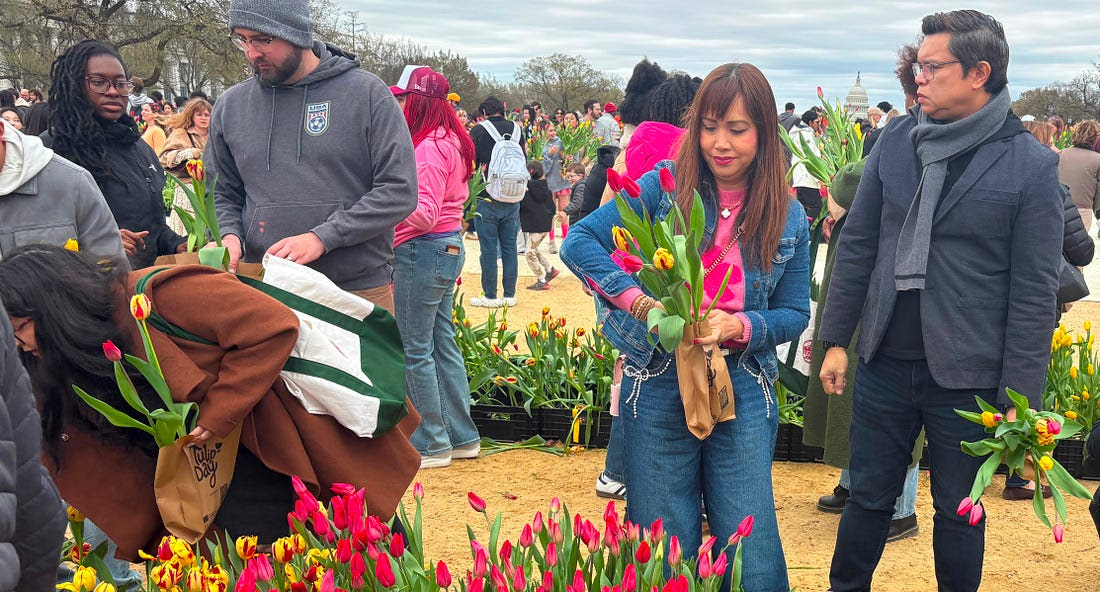
The National Mall traded its usual vast open lawns for something far more colorful and stunning ---a sea of red, yellow, white, orange, pink and two-toned tulips. The mall became a living garden – roughly 150,000 tulips were arranged in neat vibrant rows stretching toward the U.S. Capitol.
The tulip is a defining a defining national symbol of The Netherlands, representing profound economic, historical and cultural significance. As the world’s leading exporter, The Netherlands produces roughly 2 billion tulips annually, controlling 44% of the global trade. Culturally, tulips symbolize beauty and renewal, with deep roots in the 17th century. Display tulips in the 17th century became a way to show wealth and sophistication, similar to owing fine art or expensive jewelry.
Oddly, Tulips weren’t native to Western Europe. They were brought from the Ottoman Empire in the late 1500s. Their bright colors and unusual patterns (caused by a virus, though people didn’t know that at the time) made them feel rare and luxurious.
Visitors entered in timed waves, many clutching the coveted free tickets that had disappeared within minutes of release. By late morning, lines formed along the pathways as people waited their turn to step into the blooms. The anticipation felt closer to a concert than a garden visit.

Unlike traditional flower displays, this one invited participation. Each guest was allowed to pick up to ten tulips, carefully selecting stems from reds, yellows, purples, and pinks before wrapping them into small, personal bouquets in a brown paper bag.
This was the first time “Tulip Day” had come to Washington in this form, modeled after similar events in Europe and other U.S. cities. Organizers, including Royal Anthos, The Embassy of the Kingdom, of The Netherlands and provider Bloomia, framed the event as both a celebration of spring and a symbol of cultural exchange. A special floral design even incorporated “250,” out frigid winter. The timing of this event was perfect just before the D.C.’s famous cherry blossoms take center stage.

What made the day stand out wasn’t just the volume of tulips, but the way they reshaped a familiar space. The usual version of the Mall evolved into an endless colorful canvas reminiscent of a Monet, Degas or Van Gogh. By late afternoon, the once-dense field had thinned. Buckets filled, stems vanished, and patches of soil reappeared where color had been hours before. The installation was designed to disappear, carried home one bouquet at a time.
Events on the National Mall often aim for permanence memorials, marches, history etched in stone. Tulip Day was the opposite: temporary, tactile, and quietly joyful which was evident in hundreds of people walking the mall with bouquets of spring.