
The Italian Job
A Memoir of an American Reporter in Rome
“The truth was that the country where I thought I landed on a lark, the country I had once hoped would lend me a patina of esoteric, old-world sophistication, had become my home, the place I most wanted to be.” Jason Horowitz
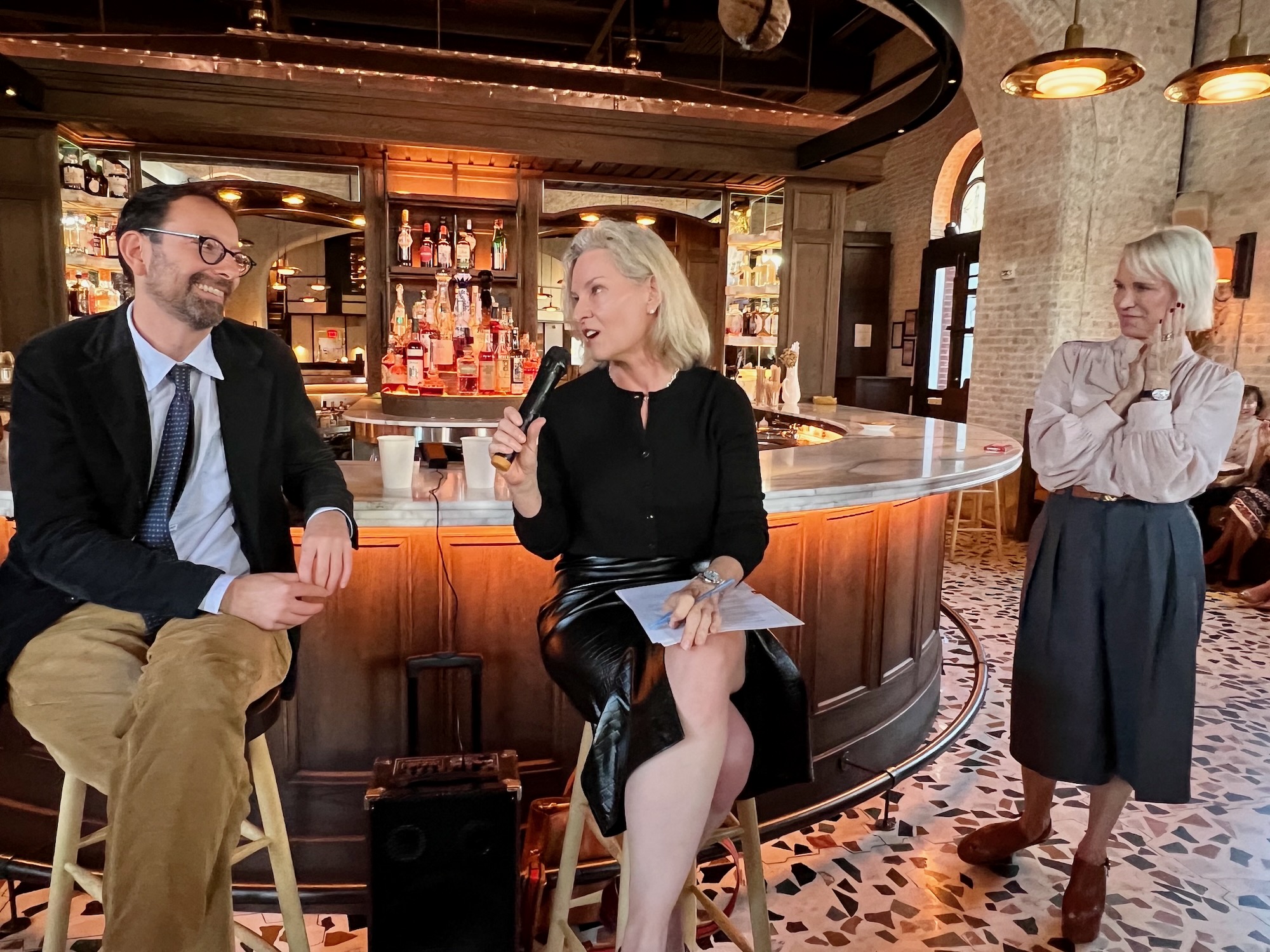
Elizabeth Miller and Dan Sallick hosted a Georgetown celebration for Jason Horowitz's new book, The Italian Job: A Memoir of an American Reporter in Rome at Osteria Mozza last Wednesday. NPR host Mary Louise Kelly moderated the lively conversation about covering Italy for a quarter century, and five years as the Rome Bureau Chief of The New York Times.

After introductions and Jason saying how happy he was to be back in DC, “Georgetown in October is unbelievable,” Mary Louise asked him about moving to Italy as a college kid, eating all his best meals at the McDonald’s at the Florence train station, and eventually finding his way to bureau chief of The New York Times.
“I went to the old world looking for sophistication, and obviously just came back as a kid from Queens, not transformed but something had been planted.”
After a 1998 semester abroad, he returned as an Associated Press intern in Rome, then freelanced for publications interviewing public figures. As he worked his way up at the bureau, Jason learned the language and met his future wife who taught him to park. “I believe in legal parking spots and Claudia taught me if there’s a spot you can go in, a cop understands.”
About the fascinating people he interviewed including Mussolini’s granddaughter, soccer stars, and four popes, Mary Louise started with politics and Silvio Berlusconi, media mogul and four-time prime minister.
“He started out in real estate, built up a ton of Milan and all around Italy, transitioned into media and ended up revolutionizing Italian and European media. It was illegal when he first came to have a private network, only government could control the broadcasting. He did this amazing thing, he bought all the local channels and made tapes, and distributed them so that they would all press play at the same moment and create a national broadcasting. He becomes one of the richest guys in Europe but he’s got a lot of people who hate him and he’s got some shady mob history. So he decides the only way to protect his business, to keep these prosecutors from coming after him is to run the country. And it works. In 1994 he becomes prime minister after a very short campaign.”
Jason explained that it was a really important historical moment not just for Italy, “because what he does to become prime minister, with not enough support alone, was to bring in the far right who had been marginalized.

“He was the most fun character in the world. His appetites were legend, the scandals, elegant dinners which were more than elegant dinners. He had this lasting impact on politics not just in Italy.”
“Listening to you describing a real estate mogul with outsize appetites for all kinds of things, who has some shady business dealings and decides the only way that he can stay on the right side of the courts is to go run the country, Is it fair to say that Berlusconi set the mold for Trump,” Mary Louise asks.

“The similarities are also the obsession with hair, but differences are really important and I remember talking to Trump about his father and what would he have said about his running for president. ‘He would absolutely allow me to do it.’ That was like weird. Wow, he was in his 70s. There was no way Berlusconi would ever say that. Berlusconi was fully formed and he was self-made and actually hated the comparisons to Trump because he did not think Trump was self-made. For all his enormous faults, I do think Berlusconi believed that he believed in Italian democracy and that he was a champion of it and that he was only trying to unshackle Italians from bureaucracy and unnecessary laws and free Italians up to be the ingenious innovative people that they were. In the end, the most optimistic guy ever. ‘Carry sunshine in your pocket’ he would say, and that was not my experience with Trump. Thats the difference.”
The pope is in the news this morning, Mary Louise mentions. “Transparency was not exactly the Vatican’s strong suit. One thing I’ve learned covering the Vatican is to take it with an enormous grain of salt whatever they say. John Paul II was, according them, eating 10 cookies the moment he died but he had a tube down his throat. They lied.
Now to have the pope not be well in the same way that Francis was, missing part of his lung his whole life and here’s this odd echo that now Leo is missing part of his lung, I hope he is well. I wonder if this will accelerate whatever he plans to do.”

Between reporting on the health of the pope, Vatican sex scandals, the effects of climate change on Venice’s canals, and Italy’s declining birth rate, the author traveled around the country. “We got lost in the quiet streets of Venice, walking back and forth over the canals on arched footbridges that reminded me of parentheses, as if we wandered through our own private aside.”
There was also time for ‘the adorable pasta grannies’ in Bari, capital of Puglia. “I ate well. The pasta is incredibly varied and totally different around the country, It’s the most rewarding place in the world to travel and eat.”
Candid, insightful and funny, Jason’s memoir is a loving snapshot of a country in transition, filled with contradictions, one focused on family and generational thinking.
An absolute must-read, something I did immediately following the celebration.
The book is available locally from Bridge Street Books.