
Don't Miss The Georgetown House Tour
This Saturday, April 18th.
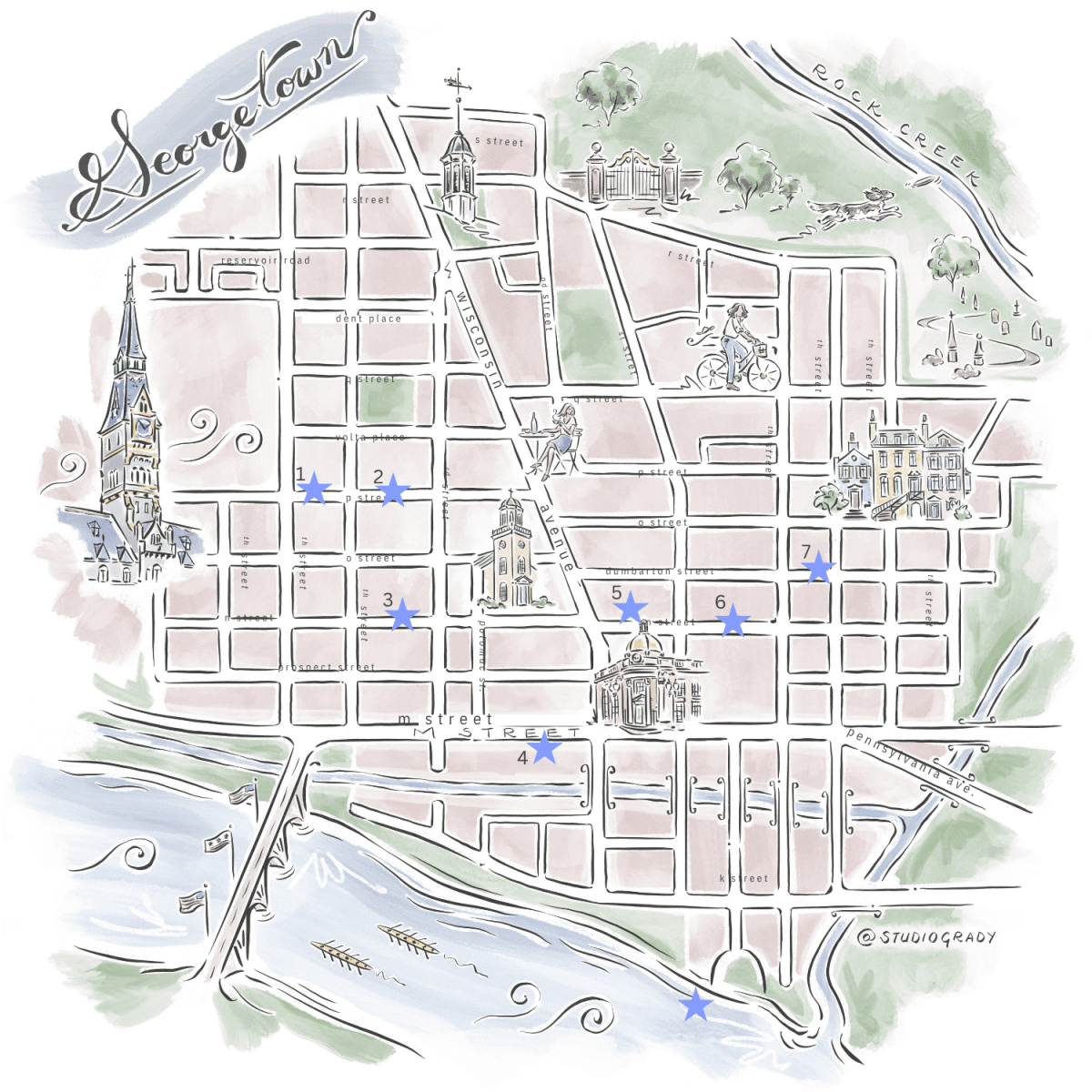
Tickets are still available for the 93rd Georgetown House Tour! Purchase here.
Homes will be open from 11 am to 5 pm on Saturday, April 18, 2026.
Participating houses on this year’s tour include:

1. 3017 N Street, NW – The Newton Baker House. The Newton D. Baker House takes its name from its owner from 1916–1920, who served as Acting Secretary of War during World War I. However, the home was originally built much earlier, in 1794, and was later combined with a neighboring carriage house that had been renovated for the Ambassador to Canada in 1951.
Many affectionately refer to the older portion of the home as the “Jacqueline Kennedy house,” reflecting her ownership after leaving the White House in 1963 following the assassination of President John F. Kennedy. She sold the house in 1965 before moving to New York. Coincidentally, Michael Whitney Straight, who purchased the home from Mrs. Kennedy, later married her stepsister, Nina Auchincloss Steers, while living here. Steers was the daughter of Nina Gore and Hugh Auchincloss and the half-sister of writer Gore Vidal.
In 1976, Yolande Betbeze Fox, Miss America 1951, purchased the home and lived there until her death in February 2016. Many neighbors still recall the estate sale, which once again brought attention to this remarkable property.
The three properties seen today were combined by a previous owner and featured on the tour a decade ago. The current homeowners, passionate about historic preservation, have undertaken a thoughtful restoration to fully unify the three structures. Working with designer Michael S. Smith and contractor BOWA, the home was recently featured in the March 2026 issue of Town & Country. Smith, known for his work on the Obama White House, was a natural choice to honor this Washington landmark.
Within the newest section of the home is a room originally conceived by former owner and designer Sally Gresham, in collaboration with architect Greg Steck. It recreates the Music Room of No. 20 St. James’s Square in London, originally designed by Robert Adam in 1772. Michael S. Smith and BOWA later reinterpreted and rebuilt the space, which now serves as an elegant entertaining room, the final space visitors will experience before exiting.

2. 3301 N Street, NW. Known locally as the “house with the lions,” this impressive Neo-Georgian brick residence has anchored the corner of N and Potomac Streets since 1916, when it was built for Dr. Michael Ready by Gaskins & Son.
The home underwent a comprehensive renovation in 2017 by BVA BarnesVanze Architects. Every room was carefully updated, including the two-car garage, while preserving the historic character. The floor plan was thoughtfully opened to improve flow between spaces without compromising architectural integrity.
The interiors reflect the current owner’s sophisticated design sensibility, resulting in spaces that feel both authentic and deeply personal, evolving alongside the family over time. In the front hall, a water-damaged wallcovering presented an opportunity for renewal. Rather than replace it with something new, the original wallpaper was meticulously sourced and reinstalled, preserving the integrity of the design. The dining room features a Venetian mirror acquired in Venice in the 1970s, rich in both history and family significance.
As the homeowner’s children have grown into adulthood, the interiors have subtly matured as well, retaining warmth and character while embracing a more refined aesthetic.

3. 3417 P Street, NW – Nelson Cunningham. This residence can be understood as two distinct structures joined into a single home. The eastern portion was built in 1887 as a carriage house and stables by contractor William Herron, serving his nearby residence on 35th Street.
The building was separated from that property in 1945 and sold to Bernice Morris, a State Department specialist in Latin American affairs. In 1951, Wesley Steele, renowned organist of St. John’s Church in Lafayette Square, purchased the carriage house, expanded it with a two-story guesthouse, and established the garden. The home was featured in the 1967 Georgetown House Tour, when visitors were invited to view Steele’s personal pipe organ. The house was last on the tour 12 years ago after a sensitive renovation by the current owner and architect Dale Overmeyer restored the exposed beams in the living room, relocated the kitchen to the garden level overlooking the pool, and re-landscaped the grounds to unify the two structures.
Approaching from P Street, visitors can observe the original carriage doors and preserved brick carriage tracks. By the entrance stands a 15th Century Italian door and a flight of flagstone stairs ascending to the living level of the house. Entry today is through the kitchen, which features a working fireplace and Dutch tilework, and opens into a sitting room overlooking the garden, which was designed by the homeowner and DCA Landscape Architects.
The skylit living and dining area forms the heart of the home, anchored by a large, leather-covered round dining table that inspired the room’s design. Among the artwork is a rare 1830 map of the Potomac and Georgetown displayed above a Federal sideboard.
A narrow passage leads to a “bridge” connecting the original carriage house to the guesthouse addition. The unusually large garden, rare for Georgetown, includes a pool and an upper terrace dining area beneath a magnolia tree beside a fountain, creating a serene, light-filled retreat.

4. 3315 P Street, NW – Jackie & John Coombe. Built in 1905 by architect J. H. McIntyre for Laura Fearson, with construction by J. A. S. Young, this residence reflects the enduring elegance of early 20th-century Georgetown architecture. Guided by a discerning eye and a love of French culture and aesthetics, the owners completed a total renovation and three-story rear addition in 2025. The result is a beautifully tailored home that now serves as the lively hub for a family with three children under seven.
As you approach, note that each side of P Street is lined with continuous rows of townhouses, all built at the same time. Washington and Georgetown grew rapidly after 1870, transitioning from an agricultural and shipping economy to one shaped by motor transport, trolley lines, and purpose-built residential neighborhoods. Number 3315 is a strong example of this evolution, originally designed for middle-class city living.
Today, the ground level has been expanded from a previously unfinished basement into a highly functional living space. The entry vestibule features reclaimed Italian marble tiles and a 19th century Gothic Revival bench. The thoughtfully designed playroom—even hiding a children’s “rabbit hole” under the stairs—connects to a fully equipped exercise room and an adjacent laundry room.
Upstairs, a newly constructed staircase leads to a striking formal dining room, wrapped in Pierre Frey’s “Au Bord du Lac” wallpaper and featuring pillow-edged solid white oak chevron floors, a sinuous handrail, and sculptural newel posts. The dining table seats twelve, with full-height cabinets discreetly concealing a hidden bar.
To the left, the sophisticated living room is bathed in warm southern light, offering cozy nooks for reading, play, and relaxation. A 19th century Louis XV style mantle with its original hearth and a nearly six-foot 19th century Napolean III-style trumeau mirror decorated with poppies complete the space. The painting that anchors the room has a special history, be sure to ask.
To the right of the staircase, jib doors hide a powder room and pantry, while large windows and doors draw your eye through the relocated kitchen toward the garden. Gone is the formerly hardscaped space, replaced by a quiet, sunlit lawn designed for family life. Such a green, open space is a rarity in Georgetown—an inviting place to pause before you leave 3315.

5. 3127 N Street, NW – Eric Shin and Malorie Blake Shin. This grand Victorian residence dates to the late 19th century, as Georgetown was emerging as one of Washington’s most desirable neighborhoods. A building permit filed on March 22, 1897, records its construction for original owner Michael V. Moran, designed by architect N. Grimm at a cost of $6,500. The home is a striking example of Romanesque Revival architecture, characterized by heavy masonry, rounded stone arches, and a richly textured façade.
From 1941 to 1951, the house operated as a rooming home for young women, reflecting increased housing demand during and after World War II. Residents shared communal amenities, including a basement equipped with multiple large refrigerators, an evocative detail of mid-century urban life.
In 1986, the home was purchased by journalists Andrew and Leslie Cockburn, who raised their daughter, actress Olivia Wilde, here. The house remained in the family for decades, preserving personal touches such as a kitchen cabinet marked with the children’s heights over the years.
The current owners acquired the property in 2022 and completed a thoughtful renovation in 2025 in collaboration with BVA BarnesVanze Architects, Zoe Feldman Design, and Fajen & Brown. The kitchen was relocated to the center of the home as a gathering space, and the former double parlor now incorporates a dining area centered around a remarkable black walnut table crafted from a single tree and air-dried for five years.

6. 2913 Dumbarton Street, NW – Danielle Naeve. This home was constructed in 1869 for John Davidson, the first proprietor of the neighborhood grocery store that today is Shelle’s Market, a long-standing Georgetown fixture. Built in the years following the Civil War, the home reflects the modest yet enduring character of Georgetown’s late 19th-century residential architecture, a period when the neighborhood was evolving into the vibrant community we know today.
In 2023, Georgetown resident and interior designer Danielle Naeve purchased the home and soon began formulating plans to thoughtfully update and revitalize the space while honoring its historic roots. Collaborating with Thompson & Cooke Architects, she reimagined the residence as a “tiny jewel box,” blending timeless architectural details with refined, modern design. With the craftsmanship of WTC, this vision was brought to life, resulting in a home that seamlessly bridges Georgetown’s rich past with contemporary elegance.

7. 3206 M Street, NW – City Tavern. Built in 1796, the City Tavern is one of the oldest surviving commercial buildings in Washington, D.C., and the city’s last remaining Federal-era tavern. Located in Georgetown during its time as a thriving port, it quickly became a hub of social, political, and civic life. In its early years, the tavern hosted prominent figures including George Washington, Thomas Jefferson, and John Adams, and served as the site of important public gatherings welcoming leaders to the new federal capital.
The building continued operating as an inn and tavern through the 19th and early 20th centuries before falling into decline. In 1959, preservationists intervened to save it from demolition, leading to a careful restoration and reopening in 1962 as the City Tavern Club. The private club operated for more than 60 years and was later listed on the National Register of Historic Places.
After closing in 2024, the building entered a new chapter under ownership committed to its preservation. Today, City Tavern continues its long tradition as a gathering place, connecting visitors with more than two centuries of Georgetown history.