
Breaking Barriers
The latest from Hollywood on the Potomac.
Written by Tamara Buchwald
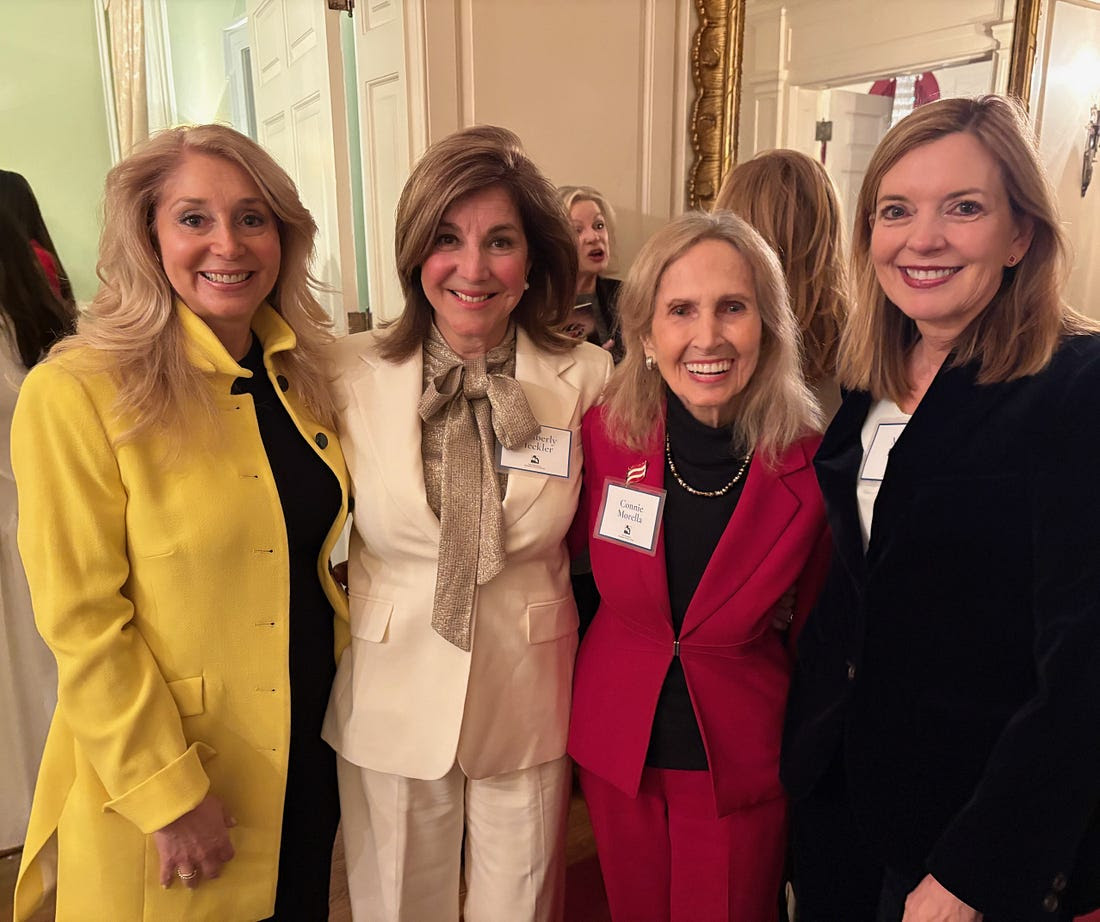
A distinguished audience gathered at the historic Woodrow Wilson House to celebrate International Women’s Day with an event honoring one of the most consequential female leaders in modern American political history. The occasion marked a special discussion with bestselling author Kimberly Heckler, whose acclaimed biography A Woman of Firsts: Margaret Heckler, Political Trailblazer has quickly become a must-read for students of politics, leadership, and women’s history. Recently named one of the top five selections on the Harvard Kennedy School Women and Public Policy Program’s 2025 Summer Reading List, Heckler’s book has been widely praised as both timely and inspiring an illuminating portrait of a woman who repeatedly broke barriers at the highest levels of government.
The evening’s setting could hardly have been more fitting. The Woodrow Wilson House, a landmark of American political heritage in the heart of Washington, provided an elegant backdrop for a conversation about leadership, public service, and the evolution of women’s roles in national life.
Kimberly Heckler, the daughter-in-law of the book’s subject, offered a deeply personal and richly researched account of Margaret Heckler’s life and legacy. During the discussion, the perseverance and resilience that defined Margaret Heckler’s career were highlighted. She spoke about the obstacles Margaret Heckler faced in an era when women were often excluded from the corridors of power, and how determination, intellect, and an unwavering commitment to public service enabled her to overcome them.
From Margaret Heckler’s humble beginnings to her breaking barriers for women, overcoming hardship in her personal life was as impressive and exceptional as her professional life. She was born to Irish immigrants. Her father worked as a doorman at the Pierre hotel and her mother served as an upstairs maid at a time when want ads still warned: “No Irish Need Apply.” Because of the circumstances of the time, her parents were forced to give her up for adoption. She was adopted by a seventy -five year old woman who raised her. Because of this, her life was shadowed by abandonment issues. As a result, it gave her tremendous empathy for people. She would go on to attend Boston College Law School as the only women in her class.
For much of the 1970s and 1980s, Margaret Heckler stood among the most powerful women in the United States. At a time when women held relatively few seats of authority in Washington, she carved a path that was as historic as it was influential. Heckler served eight terms in the United States Congress, representing Massachusetts with distinction. During her tenure, she became known for her bipartisan approach and her tireless advocacy on issues ranging from healthcare and economic opportunity to equality and civil rights. In the early 1970s, even as a lawyer and congresswoman, Margaret could not obtain a credit card. Determined to change that, she joined the House Banking and Currency Committee, a fortress of thirty-seven men. She authored the law that would finally allow women credit in their own names, without the signatures of their husbands and fathers. After a year of negotiation, the Equal Credit Opportunity Act passed in 1974, guaranteeing for the first time that women could not be denied credit based on sex or marital status.
Her career reached new heights when President Ronald Reagan appointed her Secretary of Health and Human Services in 1983. In that role, she oversaw one of the largest federal departments and played a pivotal part in shaping national health policy during a complex and transformative era. She declared AIDS the nation’s number on health priority, insisting that silence and stigma could not be allowed to guide public policy.
But Heckler’s trailblazing path did not end there. She later returned to her parents’ homeland when she was appointed United States Ambassador to Ireland, where she became an immensely popular diplomatic figure and strengthened ties between the two nations. Reflecting on her life, she once said: “I am the child of Irish immigrants. My parents came with nothing. America is the land of all opportunities, I served sixteen years in Congress, became Secretary of Health and Human Service, and the first woman U.S. Ambassador to Ireland.” Taken together, these achievements earned Margaret Heckler a distinction unmatched in American political history. She remains the first and only woman to achieve what has been described as a political ‘triple crown’ serving as a member of Congress, a presidential cabinet secretary, and a U.S. ambassador.
In honoring Margaret Heckler’s life and legacy on the eve of International Women’s Day, the Woodrow Wilson House hosted more than a literary event. It provided a powerful moment of reflection on how far women have come in public life—and how the courage of trailblazers continues to shape the future.