
Behind the Mic
The latest from Hollywood on the Potomac.
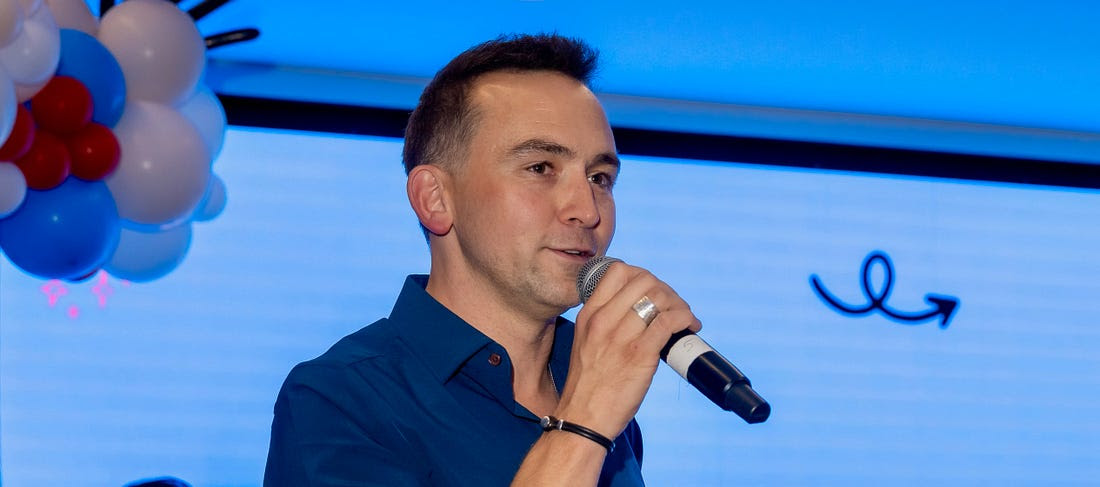
Tommy McFly is a walking invitation to have a better time: quick with a quip, curious about the person in front of him and equipped with the sort of enthusiasm Washington could use on prescription. Give him a microphone and he’ll find the story. Give him a room and he’ll find the connection. Give him a party celebrating 20 years in broadcasting at the National Association of Broadcasters and somehow a nine-pound miniature pig becomes the belle of the ball.
Naturally, there is a story behind the pig. With Tommy, there usually is.

But before the anniversary celebration, before NBC’s The Scene, before the morning radio audience and the Washington friendships, there was a kindergarten teacher who recognized that a particularly chatty child might be better served by an audience than a time-out.
“My first MC gig ever was my kindergarten graduation,” McFly recalled. His teacher was a theater person who, he suspects, saw something in him. She placed him at her desk and let him run the proceedings. There was a tuxedo. There is photographic evidence.
By first grade, the career plan had acquired accessories. Assigned to make a paper doll depicting his future profession, he fashioned himself into a radio DJ, complete with a boombox clipped from the Sears catalog, a tie-dye shirt and headphones glued to his head. His mother saved it.
“That was kind of all I wanted to do.”

Photo courtesy of Tommy McFly
For a while, the law threatened to intervene. Growing up in Scranton, Pennsylvania, McFly considered becoming a lawyer; his mother worked for the district attorney. An intern in the office was attending law school while working part-time in radio. To a 14-year-old Tommy, this seemed an especially persuasive combination.
“So in my 14-year-old head, being on the radio made you more awesome in law school.”
Radio won. At Froggy 101, his introduction to the business involved the promotions team and a frog costume, an assignment he describes as “low budget Disney World, kicked by kids and bit by dogs at the county fair.” His first boss put him on the air at 15.
It was an apprenticeship with very little glamour and an excellent supply of material.

By 20, he had caught the attention of Washington radio veteran Jack Diamond, who hired him as a producer. McFly arrived knowing no one, settled in North Bethesda and discovered that getting a foothold in broadcasting did not automatically supply a social life.
“I had no friends. I had a tough first year here, but my first friends group was actually the DC Improv.”
An improv class introduced him to what he calls a “random smattering of people from all walks of Washington.” For someone whose career would become so intertwined with the city’s personalities, it was a fitting place to start.
Two years producing and contributing to Diamond’s show led to an evening slot at Mix. Two years after that, CBS’s 94.7 Fresh hired him to host mornings. At 24, the little boy with the paper headphones had his dream job.

Tommy and Kelly Collis. Photo credit: Hayley Olivenbaum
Alongside him was Kelly Collis, his neighbor and best friend, whose City Shop Girl website preceded her radio career. She had never been on the radio before. Together, they built an eight-year run.
When the show ended, they built a business, a broadcast app and a studio in her basement. The friendship continued well beyond the microphone: Collis was the best woman at his wedding. More recently, she collaborated with his husband and the Conrad team on a summer Greek ice cream pop-up.
“Kelly is still very much in my life.”
Television entered with an email—and a response time that should be studied by anyone hoping to get ahead in Washington. At the anniversary party, Matt Glassman reminded McFly that he had once written at 12:15 p.m. to discuss television opportunities. By 12:17, McFly had replied.
The answer was yes.

Photo courtesy of Tommy McFly
At NBC, a successful Twitter account called The Scene offered a starting point. McFly became its face as it moved to television; now, he says, it has come full circle to digital. Its subject is the region’s cultural life, a beat broad enough to accommodate both a good night out and a person quietly making the city better.
“It’s the people and the ideas that shape the culture of our area.”
Ask him why it has worked, and the answer is refreshingly free of branding jargon.
“I think I’ve just always showed up. I’ve been prepared and I’ve been nice.”
He had achieved his childhood ambition by 24. Everything since, he suggests, has carried a sense of possibility rather than entitlement.
“So I feel like I’ve been playing with house money this whole time, and I’m also very appreciative of the opportunities that I’ve been given along the way.”
That appreciation extends to the people whose stories he tells.
“This place is really special and there’s a lot of things going on here all the time, but the people who choose to live here are really something special, and I want to do right by them too.”
Which brings us back to the pig.

Photo courtesy of Judy Kurtz
Synergy attended the anniversary party with H3 Project, a homeless outreach organization McFly had covered. He describes its work helping people obtain documents, medications and housing—and the miniature pig’s unusual contribution: encouraging people to open up and trust.
“The pig was the belle of the ball,” McFly says, but his explanation gives the appearance a deeper purpose. An animal who helps someone lower their guard belongs in a celebration of a broadcaster who has made connection his business.
“This pig has a job. This pig’s changing the world.”

As for his own next chapter, McFly is energized by an industry whose future is still being worked out. He calls NBC “the best job in town” and talks eagerly about telling stories, telling the truth and finding people doing great things.
“I’m trying to figure that out as everyone else is, and that’s the excitement of it. It’s sort of like the wild west out there.”
Twenty years in, the curiosity is intact. So is the comic timing. Asked earlier about being a sidekick, he had described his early radio role as being “one instrument in the band.” By the end of our conversation, he had identified one partnership worth considering.
“I’m not interested in being a sidekick unless it’s with Synergy. I will be Synergy’s sidekick any day.”