
Behind the Lens
The latest from Hollywood on the Potomac.
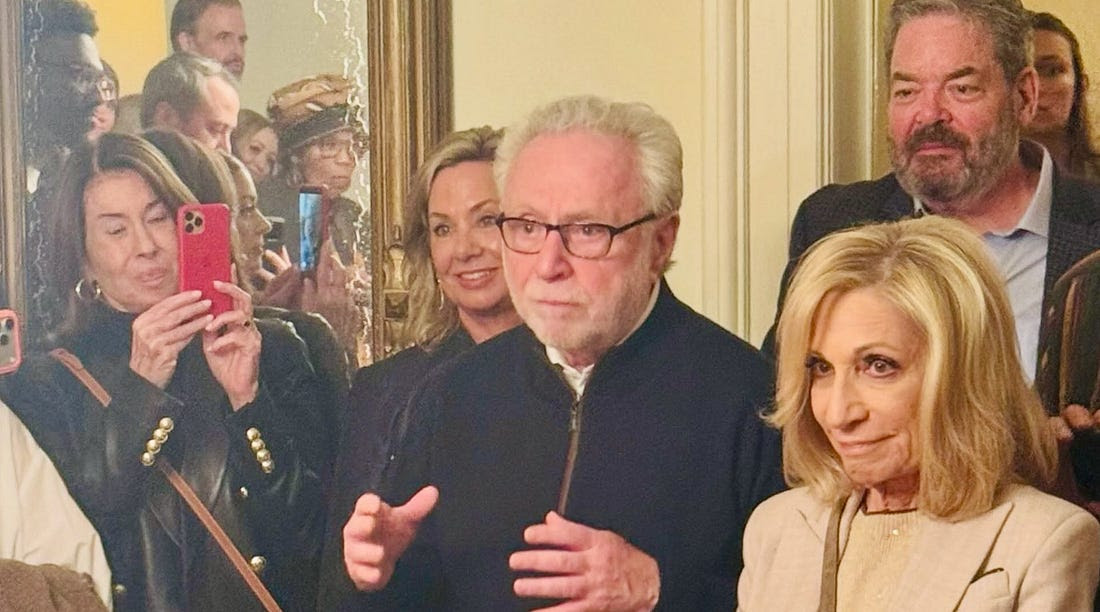
Juleanna Glover’s DC Kalorama home was the destination for a book party for a man who has spent six decades arriving with a camera. Co-hosted by Eileen O’Connor, Kathy O’Hearn and Torie Clarke, the gathering celebrated David Hume Kennerly’s In the Room: 60 Years on the Front Lines of History—a fitting title for a photographer whose career has depended on being there when the story unfolds.

Photos courtesy of Kathy O’Hearn
Kennerly has photographed Muhammad Ali, worked in the combat zones of Vietnam and been handed a White House job at 27. Yet the subject that gets our interview conversation rolling is an owl which showed up as the avatar on his zoom link. Asked about the avatar he said it was an Arctic visitor had turned up on a roof in Orange County attracting a small army of people with cameras. Kennerly joined them. “It was really fun. I got some good ones.”
There is something rather wonderful about a photographer with that résumé still getting a kick out of a bird on a roof. The curiosity is intact. So is the pleasure of coming away with a photograph.

His new book, In the Room gathers the images and stories of a career spent getting close enough to see what others might miss. Published by Rizzoli, it offers a sweeping view of a life behind the camera. In conversation, though, Kennerly is refreshingly free of the solemnity that can accompany a retrospective. He is direct, occasionally mischievous, and perfectly willing to explain how the work feels.
But let’s start at the beginning. “Well, I never wanted to do that, “ he said referring to wanting to be a fireman or policeman like many young boys. “I always wanted to be a photographer,” he said. He traces the decision to be one to around his sophomore year in high school. “And essentially I’ve been doing it since I was 16 years old, professionally since I was 19.”
The route began with pictures for his high school newspaper and yearbook, along with work for the Lake Oswego Review in Oregon. College was a brief stop. A newspaper job that was supposed to be part time became something more lasting; after military training, he went to work for The Oregonian. By late 1967, at 20, he had moved to Los Angeles to work for United Press International.
There was no elaborate reinvention along the way. He wanted to take pictures, and he found places that would pay him to do it.

Courtesy of David Hume Kennerly
Soon those places included Vietnam, where he spent two years photographing combat. His 1972 Pulitzer Prize recognized work covering the Vietnam and Cambodian wars, refugees in India and the Ali–Frazier fight. At Madison Square Garden, he caught Ali being knocked down in the 15th round. Away from the ring, he remembers a man who was approachable and enjoyed the camera. “I mean, he was a very gregarious, approachable guy. He was very cool, actually.”
Kennerly’s eye also took him inside the White House. After returning from Vietnam, he photographed Gerald Ford on Capitol Hill, beginning a relationship with Ford and his family that would lead to an extraordinary job offer. “And so when he became president the night of August 9th, 1974, he offered me the job,” Kennerly recalls. “I was 27.” As Ford’s chief White House photographer, he brought the instincts of a photojournalist to a setting where access was everything—and where the person behind the title could be as compelling as the official occasion. His affection for Ford remains uncomplicated: “I liked him a lot.”

Photo of President Ford - Courtesy of DHK
For all the famous faces, Kennerly’s most revealing observations concern people who were suffering. The question of how a photographer can keep working in the presence of distress brings him to the emotional mechanics of his profession.
“The camera in a way is kind of a shield emotionally, but not ultimately because you do think about what’s going on obviously, or you couldn’t do your job.”
The shield, in other words, has its limits. He was involved in what he saw, and he believes that involvement matters to the resulting image.
“And if you’re not sensitive to those people, to people in distress, you can’t really take good pictures, I don’t think,” he says. “You have to feel what you’re seeing, and those are reflected in the photographs.”
It is a demanding way to work: alert enough to make the photograph, open enough to absorb its meaning. Kennerly does not describe himself as someone who floated above a scene, untouched by it. Nor does he confuse doing the job with being fearless.
“No, I was scared a lot,” he says.
There were situations in which he regretted venturing out, but once there, he felt responsible for working. Courage, in his telling, involves managing the fear rather than pretending it never arrived.
“I mean, anybody that says they weren’t scared are either idiots or lying.”
Some assignments remained with him in ways no professional discipline could erase. Photographing the aftermath of Jonestown for Time was among the most difficult. The deaths of children were especially hard to comprehend.
“It was one of the worst things I ever saw.”
He believed the story had to be shown, however painful the images. That conviction sits alongside a strong sense of restraint. Getting the photograph does not, for Kennerly, justify every possible intrusion.
“I think I would never take a picture to make somebody look deliberately bad,” he says. “I mean, we all have our moments, and I don’t try to make people look good or bad. I just want to tell the story.”
He is comfortable walking into places where photographs are expected and getting on with his work. But when someone is visibly uncomfortable with his presence, he says he would not push.
“I mean, a photograph doesn’t mean that much to me that I’m going to make somebody feel bad or intrude into some private moment at a funeral or whatever.”

For a man whose career depends on access, that is a useful distinction. Being close to a subject requires judgment about what to do with the closeness.
His own life has occasionally wandered in front of the camera—or at least onto a screen. During a stretch producing television films, he executive produced a movie about the hijacking of a TWA airliner and the flight attendant who helped protect its passengers. He also wrote and produced a project shot in Thailand, with Helen Hunt in the cast and an actor playing him.
“I mean, I’m not a real showbiz guy,” he says.
Still, the Hollywood connection endured. Hunt remains a friend. Music runs through the family as well: his son Nick is a professional violinist who attended USC’s Thornton School of Music and began playing at five. Kennerly also speaks to students at USC, passing along experience from a profession he entered while barely older than they are.
The conversation eventually reaches the question he thinks deserves asking: why is he still so enthusiastic?
“I think part of it is still liking what I do and I would never quit,” he says. “And I’ve had the kind of job that I’ve loved doing. It’s not even a job really.”
Retirement holds little attraction. His measure of time was shaped much earlier, when he celebrated his 25th birthday in Saigon after heavy combat and felt fortunate simply to be alive. What followed has carried the feeling of an unexpected gift.
“When I hit 50, I doubled up. When I hit 75, I tripled up.”
That helps explain the owl, the students, the book—and the absence of any apparent desire to put the camera away. There are still things to see, and Kennerly still wants the shot.
“So I’m happy to be here.”